Green Man Triptych Sequence in Exeter Cathedral
The Green Man – known before 1939 by the perhaps better name of ‘foliate head’ or ‘foliate mask’ – is a medieval motif of foliage growing from a face. Typically the foliage is disgorged from a human face’s mouth, but sometimes it comes from other facial features, or from animals and other creatures.
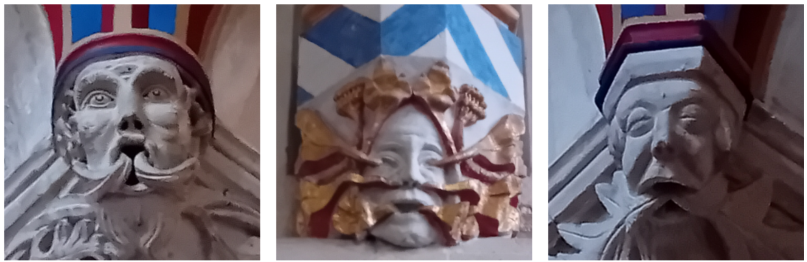
Exeter Cathedral in Devon, England, has more than 50 green man carvings.1 The oldest are at the cathedral’s east end, but my interest was particularly caught by a trio of capital carvings on the Great West Window, just by the visitor entrance.
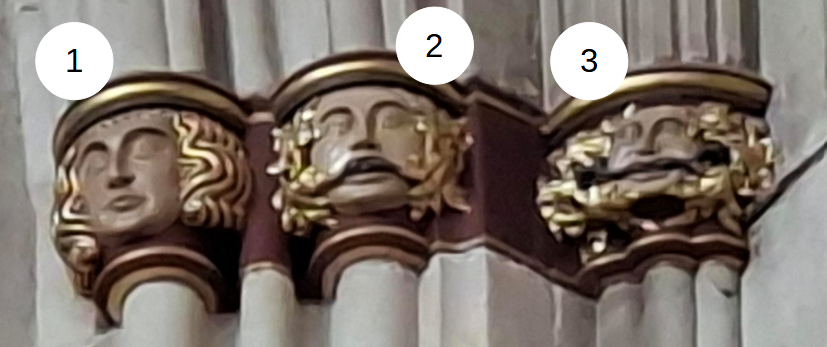
I hope to return one day and take a better photo. [Edit September 2026: slightly improved!] But even on this image quality, I think this is clearly a sequence of three carvings, showing a plain face, then the foliage starting to grow, then the foliage much grown. The facial features look the same in all three carvings, and the middle carving matches the left carving’s straight blond hair on the fringe.
I have started looking for other examples of medieval green man sequences, but so far I haven’t found any. This is not to say they don’t exist; maybe I am looking in the wrong places. Or maybe green men tend to be recorded individually rather than with their neighbours. I am reminded of Scott McCloud’s nonfiction comic about comics:
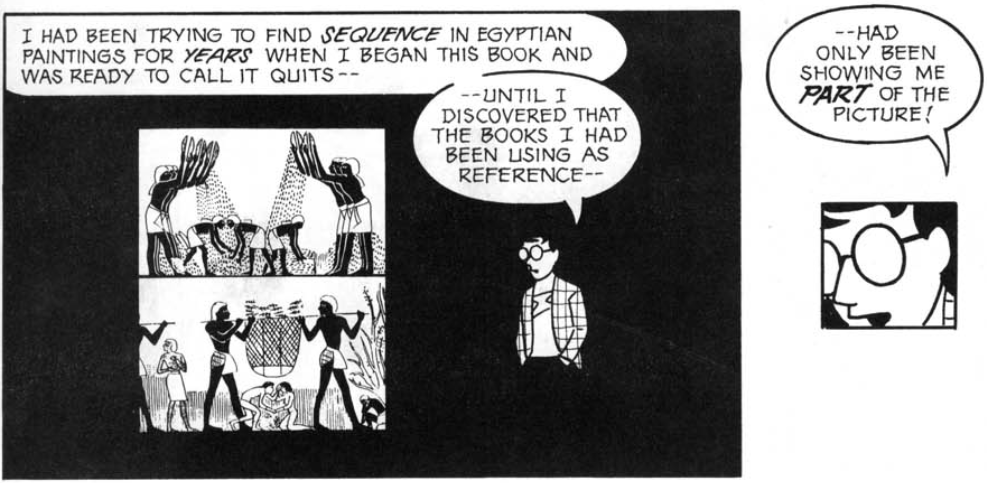
It turns out these ancient Egyptian drawings were part of a sequence, much like the Bayeux tapestry. McCloud defines comics as ‘sequential art’, however short, and the Exeter green man triptych would qualify.
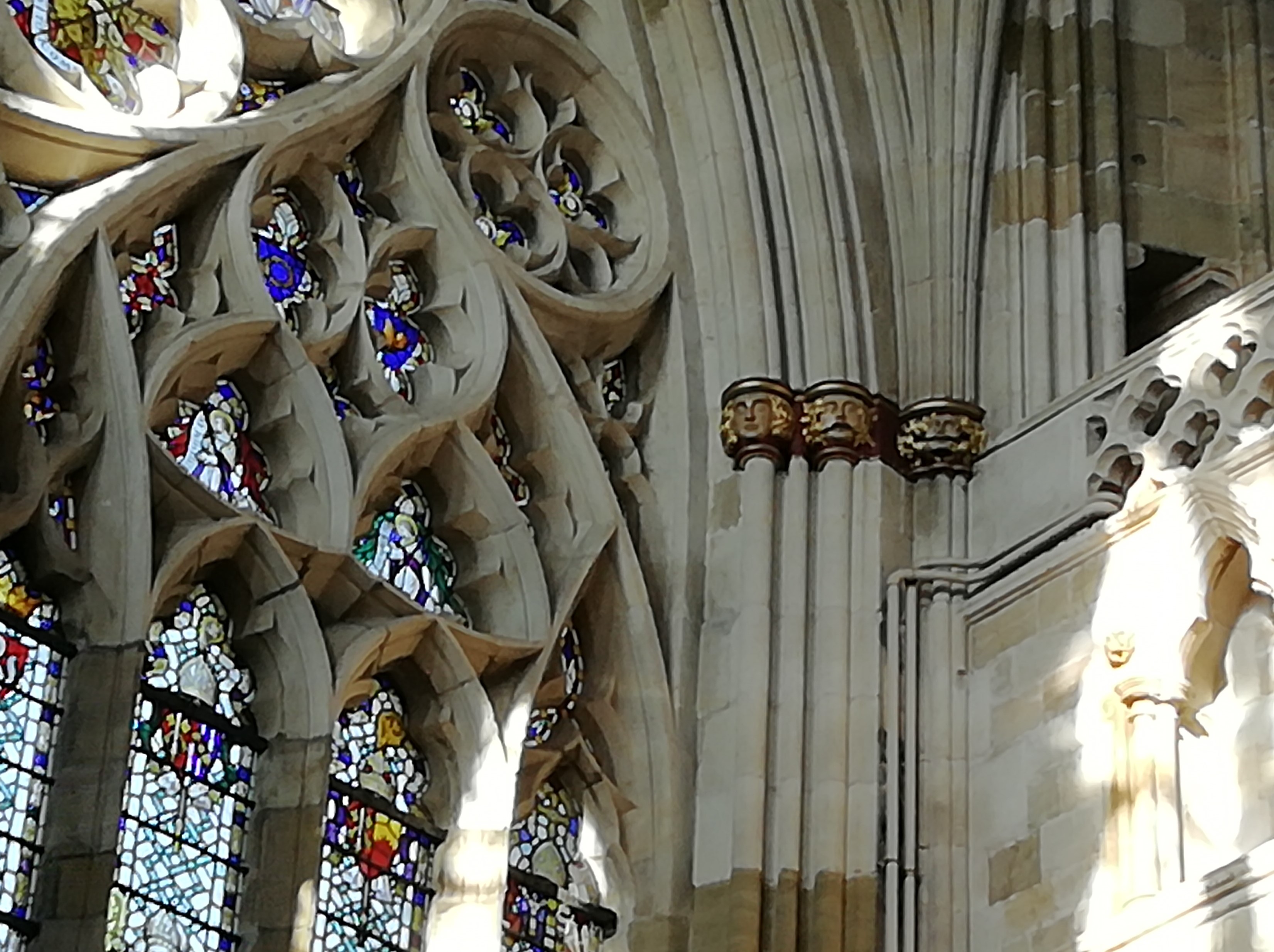
The green man triptych next to the Great West Window.
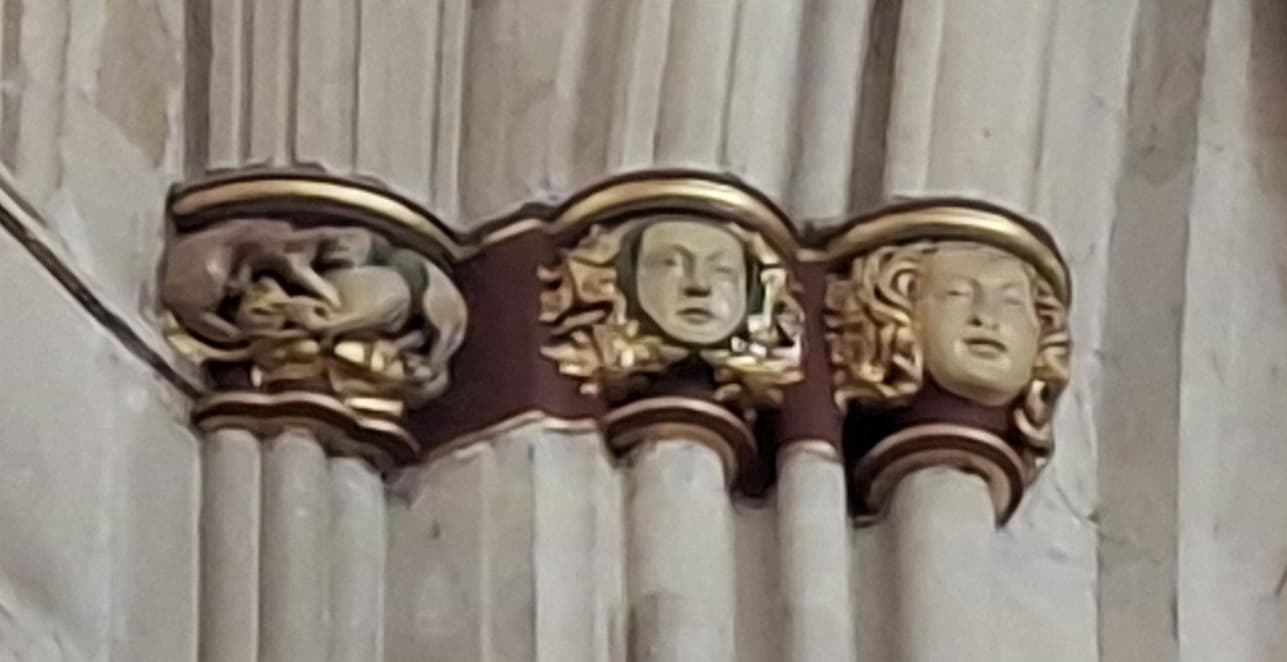
The capitals on the left side of the window seem to be a fight between two animals, a face surrounded by foliage, and a face with curly blond hair – perhaps the same character as on the right, but not apparently in sequence.
Incidentally, while I am on the topic of green men in Devon, there are several websites that claim Ottery St Mary Church – which is designed like a mini Exeter Cathedral – contains two medieval green men carvings. It actually contains three. Two are in the North Aisle; one is in the Lady Chapel.
See also: Green Men of Wells Cathedral
Edit 19 September 2026: I found a reference to Green Man groupings, although there is no hint of a sequence showing growth, like the one described above in Exeter:
“Occasionally Green Men occur in pairs, as on a roof-boss in Exeter Cathedral, or in clusters – a fine example can be found on a boss in the south aisle of Chichester Cathedral (see photo on next page), where a ring of six interlocking faces share six eyes between them. In Chartres Cathedral, near Paris, there is a group of three thirteenth-century heads, side by side above the portal of the south transept. The central head is an acanthus leaf-mask, while its companions to either side respectively disgorge vines with grapes and oak-leaves with acorns. Some Green Men have triple faces – one full and two in profile, with the latter disgorging foliage.”2
-
Keith Barker (2009) The Green Men of Exeter Cathedral gives a spotter’s guide to 54 green men – not including faces that are merely surrounded by vegetation. I can’t remember how I first found out about this book, since I can no longer find a reference to it anywhere. As far as I know, it’s only available by appointment at the cathedral library. I hope it is made more widely available, such as in the cathedral shop, as it is a useful pamphlet, and the cathedral guides and stewards apparently receive hundreds of enquiries about green men each year. ‘The interest seems to be particularly strong among American guests.’ (page 4) ↩
-
Mercia MacDermott, Explore Green Men, 2nd ed. (Orston: Heart of Albion Press, 2006; free PDF ed., 2024), p. 91, https://www.hoap.co.uk/explore_green_men.pdf. ↩