<?xml version="1.0" encoding="utf-8"?><feed xmlns="http://www.w3.org/2005/Atom" ><generator uri="https://jekyllrb.com/" version="3.10.0">Jekyll</generator><link href="https://johnden.org/feed.xml" rel="self" type="application/atom+xml" /><link href="https://johnden.org/" rel="alternate" type="text/html" /><updated>2026-04-12T22:03:40+00:00</updated><id>https://johnden.org/feed.xml</id><title type="html">John Holden</title><subtitle>Website</subtitle><author><name>John Holden</name></author><entry><title type="html">Hiking the Incheon Jongju-gil</title><link href="https://johnden.org/jongjugil" rel="alternate" type="text/html" title="Hiking the Incheon Jongju-gil" /><published>2026-01-03T00:00:00+00:00</published><updated>2026-01-03T00:00:00+00:00</updated><id>https://johnden.org/jongjugil</id><content type="html" xml:base="https://johnden.org/jongjugil"><![CDATA[<p><img src="/assets/jongjugil/2-lasthill.jpg?raw=true" alt="pavilion with city beneath" /></p>

<p>The <em>Incheon Jongju-gil</em> (인천 종주길) is a hiking trail in Incheon, South Korea. The name translates simply as “long distance trail”, but I have seen the English names “Ridge Trail” or “Green Ridge Trail” on signposts. It runs 64km in a loose S-shape from north to south, following a series of small mountains and green spaces. The highest peak is less than 400m and the mountains are right next to dense city, usually near a subway station, so this is a very accessible trail.</p>

<p><img src="/assets/jongjugil/0-firsthalf.png?raw=true" alt="Roughly the first half of the course, as seen from Soraesan" />
<em>Roughly the first half of the Jongju-gil, as seen from Soraesan</em></p>

<p>The Jongju-gil is divided into 10 “courses” (sections) of roughly equal length. There are sporadic signposts and ribbons along the way, but I found it helpful to preview each course using the very detailed notes of <a href="https://m.blog.naver.com/21robin/223242529808">one Korean blog</a> (which also includes maps, and is my source for the key features and stamp locations).</p>

<table>
  <thead>
    <tr>
      <th style="text-align: left">#</th>
      <th style="text-align: left">Course</th>
    </tr>
  </thead>
  <tbody>
    <tr>
      <td style="text-align: left">1</td>
      <td style="text-align: left"><a href="#course-1">Course 1: Gyeyangsan (계양산)</a></td>
    </tr>
    <tr>
      <td style="text-align: left">2</td>
      <td style="text-align: left"><a href="#course-2">Course 2: Cheonmasan (천마산)</a></td>
    </tr>
    <tr>
      <td style="text-align: left">3</td>
      <td style="text-align: left"><a href="#course-3">Course 3: Wonjeoksan (원적산)</a></td>
    </tr>
    <tr>
      <td style="text-align: left">4</td>
      <td style="text-align: left"><a href="#course-4">Course 4: Manwolsan (만월산)</a></td>
    </tr>
    <tr>
      <td style="text-align: left">5</td>
      <td style="text-align: left"><a href="#course-5">Course 5: Soraesan (소래산)</a></td>
    </tr>
    <tr>
      <td style="text-align: left">6</td>
      <td style="text-align: left"><a href="#course-6">Course 6: Jangsucheon (장수천)</a></td>
    </tr>
    <tr>
      <td style="text-align: left">7</td>
      <td style="text-align: left"><a href="#course-7">Course 7: Obongsan (오봉산)</a></td>
    </tr>
    <tr>
      <td style="text-align: left">8</td>
      <td style="text-align: left"><a href="#course-8">Course 8: Munhaksan (문학산)</a></td>
    </tr>
    <tr>
      <td style="text-align: left">9</td>
      <td style="text-align: left"><a href="#course-9">Course 9: Cheongryangsan (청량산)</a></td>
    </tr>
    <tr>
      <td style="text-align: left">10</td>
      <td style="text-align: left"><a href="#course-10">Course 10: Songdo International City (송도국제도시)</a></td>
    </tr>
  </tbody>
</table>

<h2 id="-course-1-gyeyangsan-계양산"><a name="#course-1"></a> Course 1: Gyeyangsan (계양산)</h2>
<ul>
  <li><strong>Key Features:</strong> Yeonmujeong Pavilion (연무정), Gyeseongjeong Pavilion (계성정), Haneujae Pass (하느재고개), Gyeyangsan Summit (계양산 정상), Helipad (헬기장), Jingmae Pass Ecological Bridge (징매이고개 생태통로)</li>
  <li><strong>Stamp Location:</strong> Gyeyangsan Summit (계양산 정상)</li>
</ul>

<p><img src="/assets/jongjugil/1-gyeyangsan.jpg?raw=true" alt="gyeyangsan" /></p>

<p>One warm spring day in 2025, I set off to begin the Jongju-gil. Gyeyangsan is a tough start to the trail, as you immediately climb over 700 stairs to the highest peak (395m). I had debated whether to bring a third bottle of water, so I was surprised to see lots of people hiking with no provisions except a thick coat and a smartphone. A pointer for English speakers: <em>san</em> means “mountain” (or hill), e.g. Gyeyangsan could be translated Gyeyang Mountain.</p>

<p><img src="/assets/jongjugil/1-summit.jpeg?raw=true" alt="summit" /></p>

<p>After more huffing and puffing than I’d care to admit, I made it to the peak. A few months later, Gyeyangsan made <a href="https://www.bbc.com/news/videos/c5ylld834mko">international news</a> for being covered in ‘lovebugs’. However on my visit, the only ‘wildlife’ to be seen at the summit was a stray cat. The trees have been trimmed to maintain a view in all directions. Despite the haze, I always love to see everyone happy and satisfied as they snap photos with the summit stone.</p>

<p><img src="/assets/jongjugil/1-gyeyangsanstampbox.jpg?raw=true" alt="stampbox" /></p>

<p>I almost forgot to use the stamp box! There is one for each of the 10 courses. If you document your progress using <a href="https://m.site.naver.com/0ouPJ">the app</a> or official stamp booklet, you can get a certificate from Incheon City Hall. I didn’t want to use roaming data for the app, nor figure out how to get the booklet, but I did enjoy collecting stamps on a scrap of paper.</p>

<p>I think these stamp boxes are a really fun idea. I’d love to see them on the hills in England. But I’ve never seen anyone else use them, and one or two were in a bad state of repair, so I’m not sure how popular they are. South Korea is a high tech society so maybe people prefer the app.</p>

<p><img src="/assets/jongjugil/1-gyeyangjeongpavilion.jpg?raw=true" alt="geyangjeongpavilion" /></p>

<p>The photo above looks southwest, towards the mountains of Course 2. Descending on the western side of Gyeyangsan is totally different to ascending from the southeast. The crowds are gone, and so are the well-built stairs. The rocky path leads all the way down to the bottom, where a tree-covered bridge crosses a highway. My backup plan was to follow the road back to Gyesan station, but to my surprise I had made good time, so I continued straight onto Course 2…</p>

<h2 id="-course-2-cheonmasan-천마산"><a name="#course-2"></a> Course 2: Cheonmasan (천마산)</h2>
<ul>
  <li><strong>Key Features:</strong> Jingmae Pass Ecological Bridge (징매이고개 생태통로), Junggubong Peak (중구봉), Cheonmasan (천마산), Hexagonal Pavilion (육각정), Cheonma Rock (천마바위), Ruwon Bridge (루원교)</li>
  <li><strong>Stamp Location:</strong> Cheonma Rock Information Board (천마바위 안내문)</li>
</ul>

<p><img src="/assets/jongjugil/2-forwardlooking.jpeg?raw=true" alt="view along path" /></p>

<p>…and I’m happy I did, because Course 2 is absolutely stunning. It follows the ridge line through a number of peaks, with panoramas down to the city on both sides – sometimes through the trees, and sometimes from a clearing.</p>

<p><img src="/assets/jongjugil/2-gyeyangsanandcheonmasan.jpg?raw=true" alt="gyeyangsan and cheonmasan" /></p>

<p>The photo above looks back to Gyeyangsan (in the distance) and Cheonmasan (middleground). An older gentleman was impressed to hear I’d come all the way from Gyeyangsan, but like many older Koreans on the mountains he looked in good shape and I suspect could have comfortably done it himself.</p>

<p><img src="/assets/jongjugil/2-lasthill.jpg?raw=true" alt="last hill with city beneath" /></p>

<p>Popular hiking photos usually show lakes and rivers. But I also enjoy cityscapes, and seeing how the city spreads around the contours of the land. I found it incredible to be walking along paths a couple of hundred metres in the sky, accompanied by the odd Oriental turtle dove, swallow and swallowtail butterfly, while sounds of chanting sports teams and urban construction drifted up from below.</p>

<p><img src="/assets/jongjugil/2-playground.jpg?raw=true" alt="playground surrounded by apartments" /></p>

<p>Eventually the trail leads back down to the city, and modernity with its pros and cons. This part of Incheon appears to be newly built. Walking to the subway station was an unhappy contrast with the mountains, walking alongside a big road and hurrying to complete 13-lane crossings before the “blue” (green) man disappeared and the black and white cars started rolling. However the neighbourhoods of tall branded apartment blocks are very pleasant; clean on the inside and outside, with tree-lined gardens.</p>

<h2 id="-course-3-wonjeoksan-원적산"><a name="#course-3"></a> Course 3: Wonjeoksan (원적산)</h2>
<ul>
  <li><strong>Key Features:</strong> Ruwon Bridge (루원교), Wonjeokjeong Pavilion (원적정), Wonjeoksan (원적산), Hambongsan (함봉산), Jang Pass (장고개), Yeoujae Pass (여우재), Baegun Park (백운공원)</li>
  <li><strong>Stamp Location:</strong> Hambongsan Summit (함봉산 정상)</li>
</ul>

<p><img src="/assets/jongjugil/3-incheon.jpeg?raw=true" alt="wonjeoksan view of incheon" /></p>

<p>I walked Course 3 on a day that was hotter than I would have liked, but on the plus side there was much less haze, giving extraordinary views over Incheon.</p>

<p><img src="/assets/jongjugil/3-adescent.jpeg?raw=true" alt="view of a descent" /></p>

<p>It was easy to follow the early peaks, but later in a forested area I went horribly off track. I was envious of Dulle-gil walkers who seemed to have hundreds of signs, while there were hardly any for the Jongju-gil. Amusingly, one signpost showed two directions for the Dulle-gil but only one for the Jongju-gil, even though it’s a through-route so there should be two for both.</p>

<p>Unfortunately when I finally doubled back and found a wooden post with Jongju-gil arrows painted on it, I was approaching from an unexpected direction, so it misled me into going back north the way I had come. At least I had company in the form of the caterpillars which hung in the air from invisible threads.</p>

<p><img src="/assets/jongjugil/3-pylon2.jpeg?raw=true" alt="pylon" /></p>

<p>Unlike Courses 1 and 2, there are lots of pylons over the Course 3 mountains. You could choose to see it as spoiling the view, but again I prefer to enjoy the combination of man-made and natural features, and contemplate the engineering effort that went into building pylons up here to bring us fast telecommunications.</p>

<p><img src="/assets/jongjugil/3-pylonsandgyeyangsan.jpeg?raw=true" alt="pylons and gyeyangsan" /></p>

<p>This photo looks back over Course 3, with a bit of Course 2 and then Gyeyangsan from Course 1 in the far distance on the right. One day I need to hike Courses 1 and 2 again in weather this clear.</p>

<h2 id="-course-4-manwolsan-만월산"><a name="#course-4"></a> Course 4: Manwolsan (만월산)</h2>
<ul>
  <li><strong>Key Features:</strong> Baegunsan Ecological Restoration Forest (백운산 생태복원 숲), Dongamsan (동암산), Manwolsan Summit (만월산 정상), Manwol to Mansusan Connecting Bridge (만월~만수산 연결다리), Salamander Village (도롱뇽마을), Bullo Mineral Spring (불로약수터), Gwanghaksan (광학산)</li>
  <li><strong>Stamp Location:</strong> Opposite Manwoljeong Pavilion (만월정 맞은편)</li>
</ul>

<p><img src="/assets/jongjugil/4-bag.jpeg?raw=true" alt="bag-with-a-view" /></p>

<p>Course 4 starts well with a smallish mountain that has exercise equipment on the top – a healthy and common sight. It then goes back down to the road and up Manwolsan.</p>

<p><img src="/assets/jongjugil/4-stone.jpeg?raw=true" alt="manwolson-summit-stone" /></p>

<p>Manwolsan is the highlight of Course 4. I love this kind of rocky summit with hardy pine trees.</p>

<p><img src="/assets/jongjugil/4-wall.jpeg?raw=true" alt="impassable-wall" /></p>

<p>Unfortunately the Jongju-gil then descends back down to a road, and this time workmen at the underpass formed their arms into an X and told me I couldn’t proceed. I was forced to take a roundabout route and try to figure out how to get from this apartment complex back onto the mountain.</p>

<p><img src="/assets/jongjugil/4-view.jpeg?raw=true" alt="view" /></p>

<p>I managed to rejoin the Jongju-gil, but regrettably I didn’t enjoy the rest of Course 4. With the sun setting behind me and a swarm of insects like Scottish midges that followed my head, I made a hasty journey along the final few peaks.</p>

<h2 id="-course-5-soraesan-소래산"><a name="#course-5"></a> Course 5: Soraesan (소래산)</h2>
<ul>
  <li><strong>Key Features:</strong> Bosei Pass (보세이고개), Incheon Grand Park (인천대공원), Geomasan (거마산), Jangsu-dong Ginkgo Tree (장수동 은행나무), Soraesan (소래산), Sangasan (상아산), Gwanmosan (관모산), Baekbeom Square (백범광장), Wetland Garden (습지원)</li>
  <li><strong>Stamp Location:</strong> Soraesan Summit (소래산 정상)</li>
</ul>

<p><img src="/assets/jongjugil/5-incheongrandpark.jpeg?raw=true" alt="incheon grand park" /></p>

<p>Course 5 skirts round the edge of Incheon Grand Park, almost in a loop. On a warm autumn Saturday, the park was full of people relaxing and playing.</p>

<p><img src="/assets/jongjugil/5-geomasan.jpeg?raw=true" alt="geomasan" /></p>

<p>Music from a band in Incheon Grand Park floated all the way to the top of Geomasan, giving a dramatic soundtrack to my descent.</p>

<p><img src="/assets/jongjugil/5-ginko.jpeg?raw=true" alt="ginkgo" /></p>

<p>Course 5 is the only stage of the Jongju-gil I have walked in deep autumn colours, part of it with a friend. It was well worth it for both of us. One local mother was so impressed to hear his English, she offered him a job tutoring her kids on the spot. And I was rewarded with a chance to see this majestic 800-year-old ginkgo tree in full yellow leaf.</p>

<p><img src="/assets/jongjugil/5-soraesan.jpeg?raw=true" alt="soraesan" /></p>

<p>Soraesan, 299.4m, is one of the highlights of the Jongju-gil. Its distinctive head-and-shoulders shape is visible from miles around. My favourite view was to the southwest (pictured), but there are great views in all directions. For some reason the official Jongju-gil path goes through a short rock-climbing section near the peak, but you can take a perfectly safe flight of steps a few metres away to the left. It felt like being on an island in the sky.</p>

<h2 id="-course-6-jangsucheon-장수천"><a name="#course-6"></a> Course 6: Jangsucheon (장수천)</h2>
<ul>
  <li><strong>Key Features:</strong> Incheon Grand Park Wetland Garden (인천대공원 습지원), Suhyeon Bridge (수현교), Jangsu Bridge (장수교), Seochang Overpass (서창고가교), Jangsujeon 1st Bridge (장수천1교), Dorim Overpass (도림고가교), Dorim Elementary School (도림초등학교)</li>
  <li><strong>Stamp Location:</strong> Jangsucheon Riverside, Shelter in front of Namdong Gymnasium (장수천변, 남동체육관 앞 쉼터)</li>
</ul>

<p><img src="/assets/jongjugil/6-stream.jpeg?raw=true" alt="stream" /></p>

<p>I enjoyed Course 6 much more than I expected. It has no mountains, but instead follows a river south from Incheon Grand Park. I gasped at seeing a kingfisher fly over a pond in the wetlands.</p>

<p><img src="/assets/jongjugil/6-river.jpeg?raw=true" alt="river" /></p>

<p>The stream grows into a river, and the reed beds on both sides become wider and wider as it cuts a course through high mud banks (and eventually would lead to the Songdo tidal flats, a key site for the endangered black-faced spoonbill). Large green/yellow/red Joro spiders made webs along the path. Due to the muddy river smells and the busy roads close by, I would not call this journey <em>pleasant</em>. But it is interesting throughout. I saw a few herons and egrets, and some ducks I couldn’t identify without binoculars.</p>

<p><img src="/assets/jongjugil/6-bridge.jpeg?raw=true" alt="underside-of-bridge" /></p>

<p>In a fantasy novel there would definitely be a forgotten civilisation living in the mud underneath the highway bridges. But in reality there were only nets and buckets for some kind of fishing.</p>

<p><img src="/assets/jongjugil/6-avenue.jpeg?raw=true" alt="avenue" /></p>

<p>After one such bridge, I was surprised by this beautiful tree-lined avenue. Sandwiched between the muddy river estuary and a highway, there was a moment to listen to a soundscape of chattering sparrows.</p>

<h2 id="-course-7-obongsan-오봉산"><a name="#course-7"></a> Course 7: Obongsan (오봉산)</h2>
<ul>
  <li><strong>Key Features:</strong> Dorim Elementary School (도림초등학교), Obongsan (오봉산), Sonangdaengi Pass (소낭댕이고개), Deumbaesan (듬배산), Sariul Park (사리울공원), Seunggi Park (승기공원), Seunggicheon Stream (승기천), Seonhak Hockey Stadium (선학 하키경기장)</li>
  <li><strong>Stamp Location:</strong> Obongsan 1st Peak (오봉산 1봉)</li>
</ul>

<p><img src="/assets/jongjugil/6-road.jpeg?raw=true" alt="highway" /></p>

<p>Course 7 begins at the foot of Obongsan, across the road from the river. I don’t like walking alongside wide roads, but crossing them on a bridge is quite enjoyable. This photo is still technically on Course 6.</p>

<p><img src="/assets/jongjugil/7-stampbox.jpeg?raw=true" alt="stampbox" /></p>

<p>‘Obongsan’ means five-peak-mountain. Alas all five peaks were forested, so I wasn’t able to get a bird’s eye view of Course 6 I had just completed. One hardy lady was walking barefoot, while others were foraging for mushrooms. Cicadas gave a constant buzzing soundtrack.</p>

<p><img src="/assets/jongjugil/7-cairn.jpeg?raw=true" alt="cairn" /></p>

<p>Cairns are quite common on the Korean mountains. This one is a looser style, pictured behind one of the ribbons that mark the Jongju-gil route, on Obongsan peak 4. Cartons of water are another common sight, intended for hikers to fight small fires before they catch hold.</p>

<p><img src="/assets/jongjugil/7-yeonsu2.jpeg?raw=true" alt="yeonsu" /></p>

<p>Course 7 then routes through a pleasant park-like apartment complex and an unpleasant set of roads. But once this was over, it opened once more into a fairly nice riverside. I saw more herons and egrets, and a cormorant. Next to a sports centre, many people were enjoying their exercise through walking, jogging and cycling.</p>

<h2 id="-course-8-munhaksan-문학산"><a name="#course-8"></a> Course 8: Munhaksan (문학산)</h2>
<ul>
  <li><strong>Key Features:</strong> Seonhak Hockey Stadium (선학 하키경기장), Munhaksan (문학산), Nojeokbong (노적봉), Songdo Station (송도역)</li>
  <li><strong>Stamp Location:</strong> Pavilion beyond Munhaksan Summit</li>
</ul>

<p><img src="/assets/jongjugil/8-pinetree.jpeg?raw=true" alt="view-from-lone-pine-tree" /></p>

<p>Course 8 follows a small mountain range from east to west. I ascended past a flock of brown-eared bulbuls, up a wooden staircase, to this lone pine tree and urban view.</p>

<p><img src="/assets/jongjugil/8-openingview.jpeg?raw=true" alt="walkway-by-rock" /></p>

<p>After the initial climb, the route is relatively easy. You follow the ridge, with the mountain slopes dropping off steeply to left and right.</p>

<p><img src="/assets/jongjugil/8-munhagsan.jpeg?raw=true" alt="munhaksan" /></p>

<p>The main feature of Course 8 is Munhaksan. Occasionally on the mountains you find old bunkers from the Korean War and boys on military duty doing exercises. Munhaksan appears to still have use for the army, and apparently it opened to the public only a few years ago.</p>

<p><img src="/assets/jongjugil/8-pavilion.jpeg?raw=true" alt="pavilion" /></p>

<p>The stamp box is towards the end of the course, at a pavilion. Always check which stamp box you are using, because not all of them are for the Jongju-gil – it would be easy to get a stamp for the Dulle-gil by mistake!</p>

<h2 id="-course-9-cheongryangsan-청량산"><a name="#course-9"></a> Course 9: Cheongryangsan (청량산)</h2>
<ul>
  <li><strong>Key Features:</strong> Songdo Station (송도역), Cheongryangsan (청량산), Bongjaesan (봉재산), Songdo MTB Park (송도MTB파크)</li>
  <li><strong>Stamp Location:</strong> Bongjaesan Summit (봉재산 정상)</li>
</ul>

<p><img src="/assets/jongjugil/9-1.jpeg?raw=true" alt="ascent" /></p>

<p>By the time I made it out to Course 9, the best of the autumn leaves had fallen. But I also enjoy the bleakness of winter. You can see more views through the trees, and somehow, like the robin in England, the <a href="https://en.wikipedia.org/wiki/Varied_tit">varied tit</a> seems particularly beautiful on bare winter branches.</p>

<p><img src="/assets/jongjugil/9-2.jpeg?raw=true" alt="view" /></p>

<p>This is the last mountain section of the Jongju-gil. It has good views down to the modern Songdo International City, which will be explored in Course 10.</p>

<p><img src="/assets/jongjugil/9-3.jpeg?raw=true" alt="field" /></p>

<p>Course 9 routes through some interesting parks. I was amazed by this field of long grass; I have not seen anything else like it in Korea. I sat in a swinging chair and listened to the chatter of Oriental magpies and the clang of apartment construction at the same time.</p>

<p><img src="/assets/jongjugil/9-4.jpeg?raw=true" alt="campus-town" /></p>

<p>This mountain biking park is overlooked by the 60 storey apartment blocks of “campus city”. There were no bikes when I visited, but the tyre marks suggested it is well used. One man canoed down the canal.</p>

<h2 id="-course-10-songdo-international-city-송도국제도시"><a name="#course-10"></a> Course 10: Songdo International City (송도국제도시)</h2>
<ul>
  <li><strong>Key Features:</strong> Songdo International Bridge (송도국제교), Saeachim Park X-Games Arena (새아침공원 X-게임장), Central Park (센트럴파크), Tri-Bowl (트라이볼), Incheon Bridge Observatory (인천대교 전망대), Art Center (아트센터), Solchan Park (솔찬공원)</li>
  <li><strong>Stamp Location:</strong> Final Point of Incheon Jongjugil (인천종주길 마지막 지점)</li>
</ul>

<p><img src="/assets/jongjugil/10-1.jpeg?raw=true" alt="central-park" /></p>

<p>Course 10 connects the green areas of Songdo International City. The Songdo area consists of 1500 acres of land reclaimed from the sea (or mud flats) in the 1990s, so this final section of the Jongju-gil is completely flat. Like Course 6, it is not a section for mountaineers, but again quite interesting from an urban-exploration perspective.</p>

<p><img src="/assets/jongjugil/10-2.jpeg?raw=true" alt="waterway" /></p>

<p>After leaving this popular city-centre waterfront, the route continues a long, long way, out to the harbour. This sounds nicer than it is, because the path is straight and exposed, and mostly next to a road. It’s also almost deserted. I wouldn’t attempt it in the heat, the rain, the wind, or with a child.</p>

<p><img src="/assets/jongjugil/10-3.jpeg?raw=true" alt="grebe" /></p>

<p>But I made the best of it. This is a black-necked grebe (I think), dwarfed by apartment blocks. Everything is super-scaled in Songdo; if you’re not driving then it’s a lengthy walk between skyscrapers. Even more than other Korean cities, the roads here are wide and fast, although not very busy: at one point I crossed a nine-lane road where not a single car was waiting.</p>

<p><img src="/assets/jongjugil/10-4.jpeg?raw=true" alt="gulls" /></p>

<p>The final stretch is along a harbour wall. To the right there are views of the impressive 21km Incheon Bridge, which connects the mainland to the airport. I navigated past lots of men and women fishing, and eventually made it to a popular boardwalk area, with people playing and cycling and disobeying signs by feeding the seagulls. I found the last stamp box, stamped a piece of card, and with that I had finished the Jongju-gil!</p>

<p>Overall, I found the Jongju-gil to be an engaging hiking route, and one that is easy to break into half-day trips. Visitors looking for more of a challenge should prioritise Courses 1, 2, 3 and 5. Those who prefer flatter, more urban walks will find Courses 6 and 10 are the best. But if time allows, the full Jongju-gil is well worth completing from start to end.</p>]]></content><author><name>John Holden</name></author><summary type="html"><![CDATA[]]></summary></entry><entry><title type="html">My Favourite Korean Baby Book</title><link href="https://johnden.org/nun-ko-ip" rel="alternate" type="text/html" title="My Favourite Korean Baby Book" /><published>2025-10-18T00:00:00+00:00</published><updated>2025-10-18T00:00:00+00:00</updated><id>https://johnden.org/nunkoip</id><content type="html" xml:base="https://johnden.org/nun-ko-ip"><![CDATA[<p>My favourite Korean baby book is <strong><em>Nun Ko Ip</em></strong> (Eyes Nose Mouth / 눈 코 입) by Baek Ju-hee, first published in 2017 by Bori Publishing Co.</p>

<p>This book is quietly brilliant.</p>

<p><img src="/assets/nunkoib/nunkoib1.jpeg" alt="frontcover" /></p>

<p>The book introduces different body parts. It could have been just one double-page spread per body part, like a non-fiction book for babies. But instead, and without any wasted words, it tells a story.</p>

<p><img src="/assets/nunkoib/nunkoib2.jpeg" alt="elephant-says-mouth" /></p>

<p>Over the first half of the book, the five characters are introduced one by one, as they announce different body parts and point to them. Young children seem to love this kind of rhythmic/repetitive structure (like <em>the Gruffalo</em>).</p>

<p><img src="/assets/nunkoib/nunkoib3.jpeg" alt="rabbit-says-head" /></p>

<p>Each page is hand illustrated and well balanced. The colour of the speech bubble on the left matches the background on the right. I love that the backgrounds are also hand painted. It adds a little bit of texture, where often there is just a plain uniform computer-generated fill. The text too is playful, wrapping around the drawings.</p>

<p><img src="/assets/nunkoib/nunkoib4.jpeg" alt="elephant-says-tail" /></p>

<p>The animals and baby on the left-hand pages all point to the body part. They are not always drawn the same way, but have different expressions on their faces. This pays off in the second half of the book, when the elephant says ‘tail!’, and the baby gets upset because he doesn’t have one.</p>

<p><img src="/assets/nunkoib/nunkoib5.jpeg" alt="rabbit-says-tummy-button" /></p>

<p>Over the next couple of pages, the animals announce ‘bottom!’ instead, which brings the baby back into the game. Then everyone is happy again, and the baby shows he is part of the group by announcing ‘tummy button!’, before they all bow and say goodbye on the last page.</p>

<h3 id="why-do-i-care">Why do I care?</h3>

<p>Do babies care that a background is hand painted rather than computer filled? Possibly not. But it’s certainly true that kids (and babies as soon as they understand) enjoy a story, and I think they enjoy seeing good artwork.</p>

<p>Also, although the purpose of a baby book is to entertain and educate the baby rather than the grown-up reading it to them, the grown-up has to read it too! So I appreciate seeing quality. I like to think the baby is learning good taste at the same time.</p>

<p>My own children’s book, <a href="https://amzn.to/4kd5pjH">A Curious Letter from Nebuchadnezzar</a>, is not a best seller. Nonetheless, I have an ambition to write some more kids’ books, such as a Bible Overview and <em>Job for Babies</em>. High quality baby books like <em>Nun Ko Ip</em> are giving me inspiration by showing the art that’s possible in simple books.</p>]]></content><author><name>John Holden</name></author><summary type="html"><![CDATA[My favourite Korean baby book is Nun Ko Ip (Eyes Nose Mouth / 눈 코 입) by Baek Ju-hee, first published in 2017 by Bori Publishing Co.]]></summary></entry><entry><title type="html">The 13 Parkruns of Surrey</title><link href="https://johnden.org/parkrun" rel="alternate" type="text/html" title="The 13 Parkruns of Surrey" /><published>2025-07-12T00:00:00+00:00</published><updated>2025-07-12T00:00:00+00:00</updated><id>https://johnden.org/parkrun</id><content type="html" xml:base="https://johnden.org/parkrun"><![CDATA[<p>Surrey has an array of beautiful <a href="https://www.parkrun.org.uk/">parkrun</a> courses, and I am on a mission to run them all. <strong>Completion status: 5/13.</strong></p>

<p><img src="/assets/surreyparkruns/gower_surrey_map13.jpg" alt="map of parkruns in surrey" /></p>

<p>A parkrunner called <a href="https://www.richardgower.com/blog/surreyparkrun">Richard Gower</a> made this map of the 13 parkruns in present-day Surrey. They are pleasingly distributed about the county. This blog post contains my course notes.</p>

<table>
  <thead>
    <tr>
      <th style="text-align: center">#</th>
      <th>Parkrun</th>
    </tr>
  </thead>
  <tbody>
    <tr>
      <td style="text-align: center">1</td>
      <td>✅ <a href="#banstead-woods">Banstead Woods</a></td>
    </tr>
    <tr>
      <td style="text-align: center">2</td>
      <td>⏳ <a href="#broadwater">Broadwater</a></td>
    </tr>
    <tr>
      <td style="text-align: center">3</td>
      <td>✅ <a href="#brooklands">Brooklands</a></td>
    </tr>
    <tr>
      <td style="text-align: center">4</td>
      <td>⏳ <a href="#cranleigh">Cranleigh</a></td>
    </tr>
    <tr>
      <td style="text-align: center">5</td>
      <td>⏳ <a href="#egham-orbit">Egham Orbit</a></td>
    </tr>
    <tr>
      <td style="text-align: center">6</td>
      <td>⏳ <a href="#frimley-lodge">Frimley Lodge</a></td>
    </tr>
    <tr>
      <td style="text-align: center">7</td>
      <td>❌ <a href="#guildford">Guildford</a></td>
    </tr>
    <tr>
      <td style="text-align: center">8</td>
      <td>⏳ <a href="#hazelwood">Hazelwood</a></td>
    </tr>
    <tr>
      <td style="text-align: center">9</td>
      <td>✅ <a href="#homewood">Homewood</a></td>
    </tr>
    <tr>
      <td style="text-align: center">10</td>
      <td>✅ <a href="#mole-valley">Mole Valley</a></td>
    </tr>
    <tr>
      <td style="text-align: center">11</td>
      <td>✅ <a href="#nonsuch">Nonsuch</a></td>
    </tr>
    <tr>
      <td style="text-align: center">12</td>
      <td>⏳ <a href="#reigate-priory">Reigate Priory</a></td>
    </tr>
    <tr>
      <td style="text-align: center">13</td>
      <td>⏳ <a href="#woking">Woking</a></td>
    </tr>
  </tbody>
</table>

<h3 id="banstead-woods">Banstead Woods</h3>
<p>I like woodland, so this course is one of my favourites. On a late summer’s day I was too early for the autumn leaves but enjoyed the dappled light shining in patches through the canopy. I’m afraid my photos are horribly blurred as I didn’t want to stop to hold my camera still.</p>

<p><img src="/assets/surreyparkruns/ban1.jpeg" alt="image" /></p>

<p>At the halfway point I was surprised by an unexpectedly good time, only to be immediately hit by a steep uphill that took all the energy from my legs. Watch your step – I saw two people fall (and be helped up by friendly parkrunners), and a man I spoke to after had a similar tale of woe. The guide said it’s because rubble from a buried Prisoner of War camp is slowly being exposed.</p>

<p><img src="/assets/surreyparkruns/ban2.jpg" alt="image" /></p>

<p>On my visit, there happened to be two notable milestones. One runner joined the “422 club” – a local tradition of recognising 422 runs, with at least 250 at Banstead Woods, in honour of a popular runner called Alan Collis who ran 422 times before he passed away. And a lady in the 75-79 age range completed her 100th parkrun, having been present at the very first Banstead Woods event back in 2007. Inspiring.</p>

<h3 id="broadwater">Broadwater</h3>
<p>Not yet visited.</p>

<h3 id="brooklands">Brooklands</h3>
<p><img src="/assets/surreyparkruns/brooklands3.jpeg" alt="image" /></p>

<p>Brooklands is a historic aerodrome and motor racing circuit. The parkrun begins on the old runway, where the guide delivered a funny flight-themed briefing.</p>

<p><img src="/assets/surreyparkruns/brooklands1.jpeg" alt="image" /></p>

<p>The bulk of the course used to be a go-kart track. You wiggle dizzyingly left and right, and if you look up you will see lines of colourful parkrunners snaking all over the place.</p>

<p><img src="/assets/surreyparkruns/brooklands2.jpeg" alt="image" /></p>

<p>Brooklands was the first purpose built ‘banked’ (sloped) motor racing course in England and the world. The old banking is visible from Tesco car park and in other places around the loop. I was hoping to run on it, but the parkrun course follows a woodland path next to the banking rather than on the banking itself. In winter I expect it would be visible through the trees, for extra historic interest.</p>

<h3 id="cranleigh">Cranleigh</h3>
<p>Not yet visited.</p>

<h3 id="egham-orbit">Egham Orbit</h3>
<p>This blog post was originally going to have the pleasing title ‘The 12 parkruns of Surrey’, before the good folk of Egham added their course. Not yet visited.</p>

<h3 id="frimley-lodge">Frimley Lodge</h3>
<p>Not yet visited.</p>

<h3 id="guildford">Guildford</h3>
<p><img src="/assets/surreyparkruns/guildford1.jpeg" alt="image" /></p>

<p>Failure! I turned up to Guildford, only to discover that it was cancelled for an event in the park. A pity, because it was a perfect day for running and the course was prettier than I expected. A few other disappointed runners set off for an unofficial parkrun. I am afraid that I did not.</p>

<p>To return.</p>

<h3 id="hazelwood">Hazelwood</h3>
<p>Not yet visited.</p>

<h3 id="homewood">Homewood</h3>
<p><img src="/assets/surreyparkruns/homewood1.jpeg" alt="image" /></p>

<p>Homewood is a lovely course. It begins beside an idyllic cricket pitch, surrounded by copper beeches and other majestic trees, then quickly disappears into woodland, up “Achilles Hill”, along “rooty row”, then bounces around a copse of pines before curving downhill back towards the start.</p>

<p><img src="/assets/surreyparkruns/homewood2.jpeg" alt="image" /></p>

<p>There is a U-shaped silver birch (not the one pictured) that called to me like the sirens of ancient mythology: while I was sizing it up for a jump, I crashed over a tree root. Luckily the ground was soft.</p>

<p><img src="/assets/surreyparkruns/homewood3.jpeg" alt="image" /></p>

<p>On my final lap, a little boy was giving us all a high five. Later when a marshal appeared through the trees and stretched out his arm, I switched my car keys to my left hand and began to raise my right for another high five, only to realise the marshal was just pointing the way. But I passed it off as a kind of wave and the awkward moment didn’t stop me enjoying this beautiful run in the countryside.</p>

<h3 id="mole-valley">Mole Valley</h3>
<p>I sat in the car at Denbies Wine Estate a few days before Christmas, listening to the rain pattering on the windscreen. In an answer to prayer it stopped just in time for a warmup and the first timers’ briefing, which warned us of mud and false summits.</p>

<p><img src="/assets/surreyparkruns/mole3.jpeg" alt="image" /></p>

<p>Mole Valley is supposed to be one of the most beautiful parkruns in the country. But I barely noticed it, because I spent the whole run looking at my feet. It quickly became apparent my 5-year-old road shoes were completely flat soled: a bad combination with liquid mud. From the first hill I was reduced to a slippery walk, seeking every tuft of grass.</p>

<p><img src="/assets/surreyparkruns/mole2.jpeg" alt="image" /></p>

<p>I had no grip at all. It was so bad that I almost bailed half way through, only to be persuaded by a marshal to carry on “just up there”. I should have listened to the first timers’ guide instead because the path continued a lot further than it appeared. “Don’t hate me,” she said on my way back.</p>

<p><img src="/assets/surreyparkruns/mole1.jpeg" alt="image" /></p>

<p>But at last I was making progress. I picked up some speed on a gravel section, and ran the final straight on grass. My final time was 45 minutes – my slowest ever, and yet I was strangely pleased with it. And to think that my original plan for the day was Brooklands, running on tarmac on a literal runway!</p>

<p>Added to Christmas list: trail running shoes.</p>

<h3 id="nonsuch">Nonsuch</h3>
<p><img src="/assets/surreyparkruns/non4.jpg" alt="image" /></p>

<p>Nonsuch is a very popular parkrun, on the boundary between Greater London and the rest of Surrey. It routinely attracts 600 runners, creating quite a buzz. Wiggle to the front to improve your time by 30 seconds!</p>

<p><img src="/assets/surreyparkruns/non1.jpg" alt="image" /></p>

<p>I love to see the long line of colourful jerseys running beneath the ancient trees. As usual in parkruns you need to watch your feet – this time especially in autumn, when one of the avenues becomes lined with conkers ready for you to slip on. One lady was enjoying her run and commented on the bouncy grass.</p>

<p><img src="/assets/surreyparkruns/nonsuch1.jpeg" alt="image" /></p>

<p>On my visit, members of the running club Epsom Harriers were pace-making, wearing 28-minute, 29-minute, 30-minute (and so on) tops. Perhaps today isn’t a fast day, I thought early on, as I sadly watched one after another overtake. But later in the run they became a useful yardstick, I picked up steam and shocked myself by almost setting a personal best.</p>

<h3 id="reigate-priory">Reigate Priory</h3>
<p>Not yet visited.</p>

<h3 id="woking">Woking</h3>
<p>Not yet visited.</p>]]></content><author><name>John Holden</name></author><summary type="html"><![CDATA[Surrey has an array of beautiful parkrun courses, and I am on a mission to run them all. Completion status: 5/13.]]></summary></entry><entry><title type="html">What I learned from reading four books on Elon Musk</title><link href="https://johnden.org/elonmusk" rel="alternate" type="text/html" title="What I learned from reading four books on Elon Musk" /><published>2025-04-25T00:00:00+00:00</published><updated>2025-04-25T00:00:00+00:00</updated><id>https://johnden.org/elonmusk</id><content type="html" xml:base="https://johnden.org/elonmusk"><![CDATA[<p>Recently I read four books about businessman Elon Musk and his companies. Two were biographies by <a href="https://www.goodreads.com/book/show/25541028-elon-musk">Ashlee Vance (2015)</a> and <a href="https://www.goodreads.com/book/show/198586342-elon-musk">Walter Isaacson (2023)</a>, and two – Eric Berger’s <em><a href="https://www.goodreads.com/book/show/53402132-liftoff">Liftoff (2021)</a></em> and <em><a href="https://www.goodreads.com/book/show/205309521-reentry">Reentry (2024)</a></em> – covered the rocket company SpaceX. When I say “read”, I actually mean “listened to”, so everything that follows is subject to recall error.</p>

<p>There are some minor discrepancies. Notably, one of the anecdotes I considered most damaging from Vance’s 2015 book – firing his personal assistant after determining he could do her job – wasn’t repeated by Berger and Isaacson. According to Isaacson, Musk said moving SpaceX launches to the middle of the Pacific was “a mistake”, which seems quite important, but isn’t reported by Berger. Isaacson also says that SpaceX tried a new method of unblocking a valve just before docking with the International Space Station, which sounds more dangerous than Berger and Vance’s report that it was a software change to ignore glare.</p>

<p>Anyway, all four books are very good (despite falling into the modern trend of using profanity in the narrative), and worth reading. If you are most interested in spaceflight, Berger’s books are obviously the place to start. For a quicker read that has a number of interesting anecdotes the other books lack, go with Vance. For more detail on Musk’s childhood, personal life and the Twitter saga, Isaacson. The story is certainly dramatic, particularly 2008, when Musk appeared forced to choose between saving SpaceX and Tesla, split his money between both, and was saved by a successful rocket launch on the final attempt.</p>

<p>Isaacson’s book tries to answer the question, could Elon Musk have kept his positives (his vision, drive, and transformational business successes) without his negatives (lack of compassion)? It concludes that the former don’t excuse the latter, and would be hard to disentangle. Sounds about right. I however went in with a more prosaic question: just how does Musk <em>do</em> so much? He is running half a dozen billion-dollar companies that are trying to change the world with low emission transport and reusable rockets. I, meanwhile, have gone more than a year without fixing my bathroom cabinet.</p>

<p>The books didn’t really answer my question. If anything they made it worse. Musk’s meetings wander on long tangents, he looks after numerous children (at least sometimes), plays video games all night, does his own scheduling, and has sent 18,000(!?) tweets. Even after sacrificing sleep and exercise, it’s hard to reconcile this with 100-hour work weeks, but apparently it’s possible.</p>

<p>I think the answer to Musk’s productivity is in part: (a) making decisions quickly, (b) multiplying his efforts by requiring his employees to work around the clock too, and (c) sheer unexplainable business brilliance. There is not much one can do about (c). (a) and (b) both come under Musk’s mantra “a maniacal sense of urgency is our operating principle” and have pluses and minuses.</p>

<p>For (a), there are big decisions and small decisions. For the big decisions, Musk is driven by his vision of the future. Electric cars <em>must</em> be made from aluminium to be lighter; rocket fuel <em>must</em> be cooled and densified to eke out the extra efficiency that allows reuse. Musk always has one eye on the future, even during a rocket launch; Isaacson describes this as a stress response.</p>

<p>For small decisions, Musk makes decisions on the spot, enabling his managers to act without the liability of taking responsibility. After implementing a decision they discover through experience whether it was right or not – and more often than not it is right, because, through reading and conversations, Musk evidently has an excellent grasp of materials and applied physics. Musk’s companies insource production wherever possible, particularly where a component has a high ‘idiot index’ (price of component divided by price of raw material), so it’s usually possible to implement these decisions rapidly.</p>

<p>Where he does get things wrong, Musk is not averse to changing course when presented with evidence, such as re-introducing a screw he tried to get rid of. Sometimes his decisiveness veers into rashness and comes at a multi-billion-dollar cost, such as agreeing to buy Twitter (and at too high a price), which he later regretted – at times he might have done better to heed Proverb 15:22: “<em>Without counsel plans fail, but with many advisers they succeed.</em>” But ultimately Musk’s nature is to forge ahead and learn from mistakes, rather than sit and ponder. Berger notes that whenever Musk is away from SpaceX for too long, it begins to lose its scrappy-startup-ness and the work slows down.</p>

<p>I was less impressed by (b), the pressure on his employees. Certainly, working for Musk’s companies, and particularly SpaceX, is more of a lifestyle than a job. Employees get rapid responsibility, quick learning, and exciting rocket launches, in return for devoting themselves to the company. I imagine many people see it as an acceptable trade-off, particularly single 20-year-olds, but I was saddened to hear of the broken families – pretty much everybody in the story seemed to get divorced. One Turkish engineer went home to see his mother only once in five years.</p>

<p>But back to more positive topics. Musk is relentless at increasing speed and slashing costs. One of the most impressive chapters described how Musk increased production at the Tesla factory. It was widely thought to be impossible – and not just by cheap-talking newspaper columnists, but by well-resourced short sellers who put millions of dollars on the line and buzzed the factory with drones to get the latest intel. Musk proved them all wrong, not through a single magic bullet, but by a series of incremental improvements. He converted a car park into extra floorspace, and walked the production line, replacing slow machines with workers, changing machine settings, and eliminating all unnecessary tasks.</p>

<p>I found it notable how Musk cares what his workspaces <em>look like</em>. For example he told one manager that rocket production should look like “a [expletive] beehive” and, even while strapped for cash, he found enough in the budget to paint the Tesla factory red and white.</p>

<p><img src="https://upload.wikimedia.org/wikipedia/commons/5/57/Tesla_auto_bots.jpg" alt="White and red Tesla factory" />
<em>(<a href="https://en.wikipedia.org/wiki/List_of_Tesla_factories#/media/File:Tesla_auto_bots.jpg">Image source: Wikipedia</a>)</em></p>

<p>Isn’t functionality more important than form? Maybe it’s not that simple. Although a futuristic factory won’t necessarily make futuristic cars or rockets, perhaps futuristic cars or rockets can only be made by a futuristic factory. It needs to look the part. Chasing form can lead to functionality as a by-product. And the environment inspires the workers and designers, and no doubt Musk himself.</p>

<p>It makes me wonder if offices are unwise to run a clear-desk policy. No doubt it’s easier for security and cleaning, but maybe something is lost by looking generic, and not having physical documents to hand. And maybe this also extends to houses. Musk doesn’t seem to have a real home. At one point he hired a famous architect, Isaacson pointed out he seemed to be building an art installation more than a home, and Musk agreed and gave up. Might Musk’s personal life have been more stable if he had a house that looked like a home? One can only speculate.</p>

<p>Overall, Musk’s companies are very impressive. For a fresh graduate in America, they could be a fascinating place to work for a few years, but anyone else should think carefully. My main takeaways are to make (small, reversible) decisions quickly, to work with short timelines, and to make my work environment – and home – look the part. Even if it starts with fixing the cabinet.</p>]]></content><author><name>John Holden</name></author><summary type="html"><![CDATA[Recently I read four books about businessman Elon Musk and his companies. Two were biographies by Ashlee Vance (2015) and Walter Isaacson (2023), and two – Eric Berger’s Liftoff (2021) and Reentry (2024) – covered the rocket company SpaceX. When I say “read”, I actually mean “listened to”, so everything that follows is subject to recall error.]]></summary></entry><entry><title type="html">Story Arcs according to Matthew Dicks</title><link href="https://johnden.org/storyarcs" rel="alternate" type="text/html" title="Story Arcs according to Matthew Dicks" /><published>2024-04-21T00:00:00+00:00</published><updated>2024-04-21T00:00:00+00:00</updated><id>https://johnden.org/storyarcs</id><content type="html" xml:base="https://johnden.org/storyarcs"><![CDATA[<blockquote>
  <p>For in Calormen, story-telling (whether the stories are true or made up) is a thing you’re taught, just as English boys and girls are taught essay-writing. The difference is that people want to hear the stories, whereas I never heard of anyone who wanted to read the essays.</p>

  <p>C.S. Lewis, The Horse and His Boy, The Chronicles of Narnia</p>
</blockquote>

<p>While researching memory palaces, I came across <a href="https://youtu.be/Bhl1-vgQ1Nk">Nelson Dellis’s recommendation</a> of <a href="https://www.goodreads.com/en/book/show/37786022">Storyworthy by Matthew Dicks</a>. I had no plans to tell stories, but I was intrigued by the strong reviews, so I decided to give it a go. I am glad I did. I still have no plans to tell stories, at least not in a ‘story slam’ style, but the book was fascinating and went far further than the simplistic ‘man in hole’ or ‘beginning middle end’ structures I’ve seen elsewhere.</p>

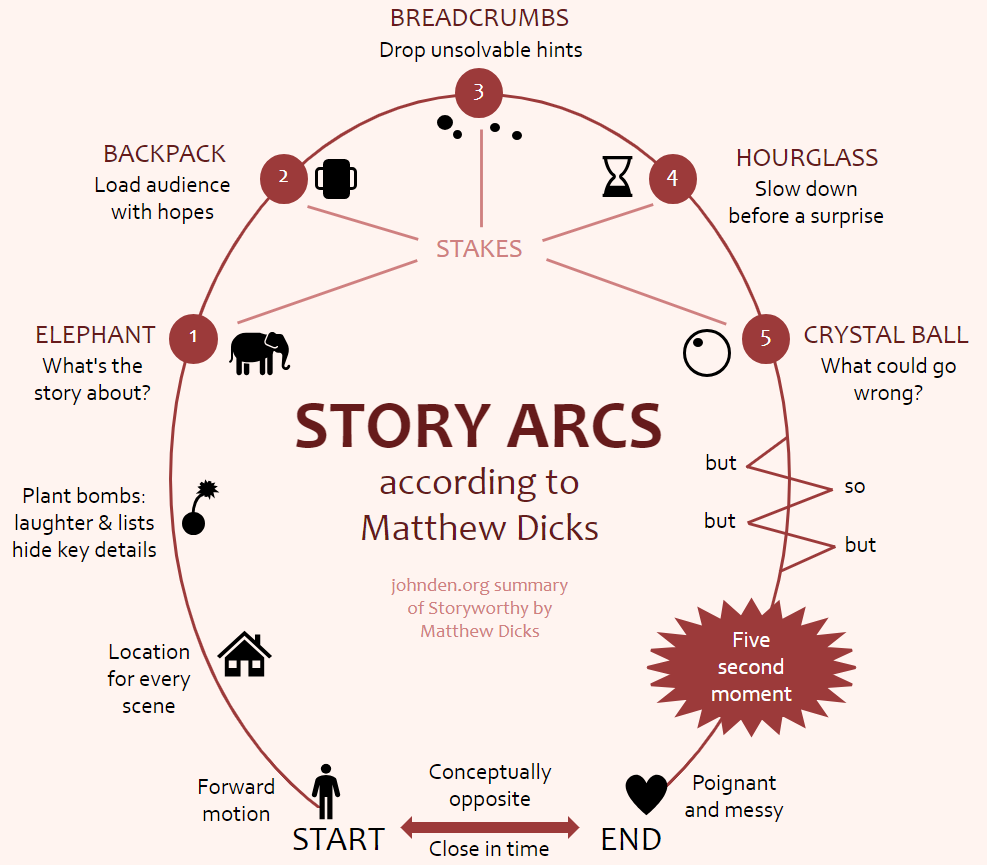
<p>The only problem was, I listened to the audiobook, and it’s hard to remember all of Matthew’s great advice. After returning to select chapters for the third or fourth time, I realised this book needs a summary diagram to jog my memory. And the concept of a ‘story arc’ lends itself nicely to an arc-shaped diagram, so I decided to draw one. Here it is:</p>

<p><img src="/assets/storyarcs/StoryArcs.png" alt="Story arcs according to Matthew Dicks diagram" /></p>

<p>According to the author, all stories revolve around a relatable ‘five second moment’ of change, that makes a strong contrast between the start and the end. The audience needs a location to visualise each scene, and the storyteller can build suspense through ‘buts’ and ‘therefores’ and careful use of stakes. There is lots more in the book than I could comfortably fit in one diagram. Recommended.</p>]]></content><author><name>John Holden</name></author><summary type="html"><![CDATA[For in Calormen, story-telling (whether the stories are true or made up) is a thing you’re taught, just as English boys and girls are taught essay-writing. The difference is that people want to hear the stories, whereas I never heard of anyone who wanted to read the essays. C.S. Lewis, The Horse and His Boy, The Chronicles of Narnia]]></summary></entry><entry><title type="html">Green Man Triptych Sequence in Exeter Cathedral</title><link href="https://johnden.org/greenman" rel="alternate" type="text/html" title="Green Man Triptych Sequence in Exeter Cathedral" /><published>2024-01-07T00:00:00+00:00</published><updated>2024-01-07T00:00:00+00:00</updated><id>https://johnden.org/greenman</id><content type="html" xml:base="https://johnden.org/greenman"><![CDATA[<p>The Green Man – known before 1939 by the perhaps better name of ‘foliate head’ or ‘foliate mask’ – is a medieval motif of foliage growing from a face. Typically the foliage is disgorged from a human face’s mouth, but sometimes it comes from other facial features, or from animals and other creatures.</p>

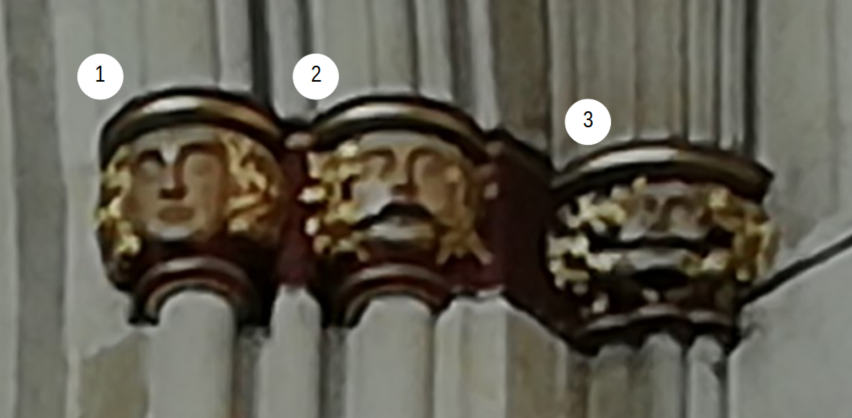
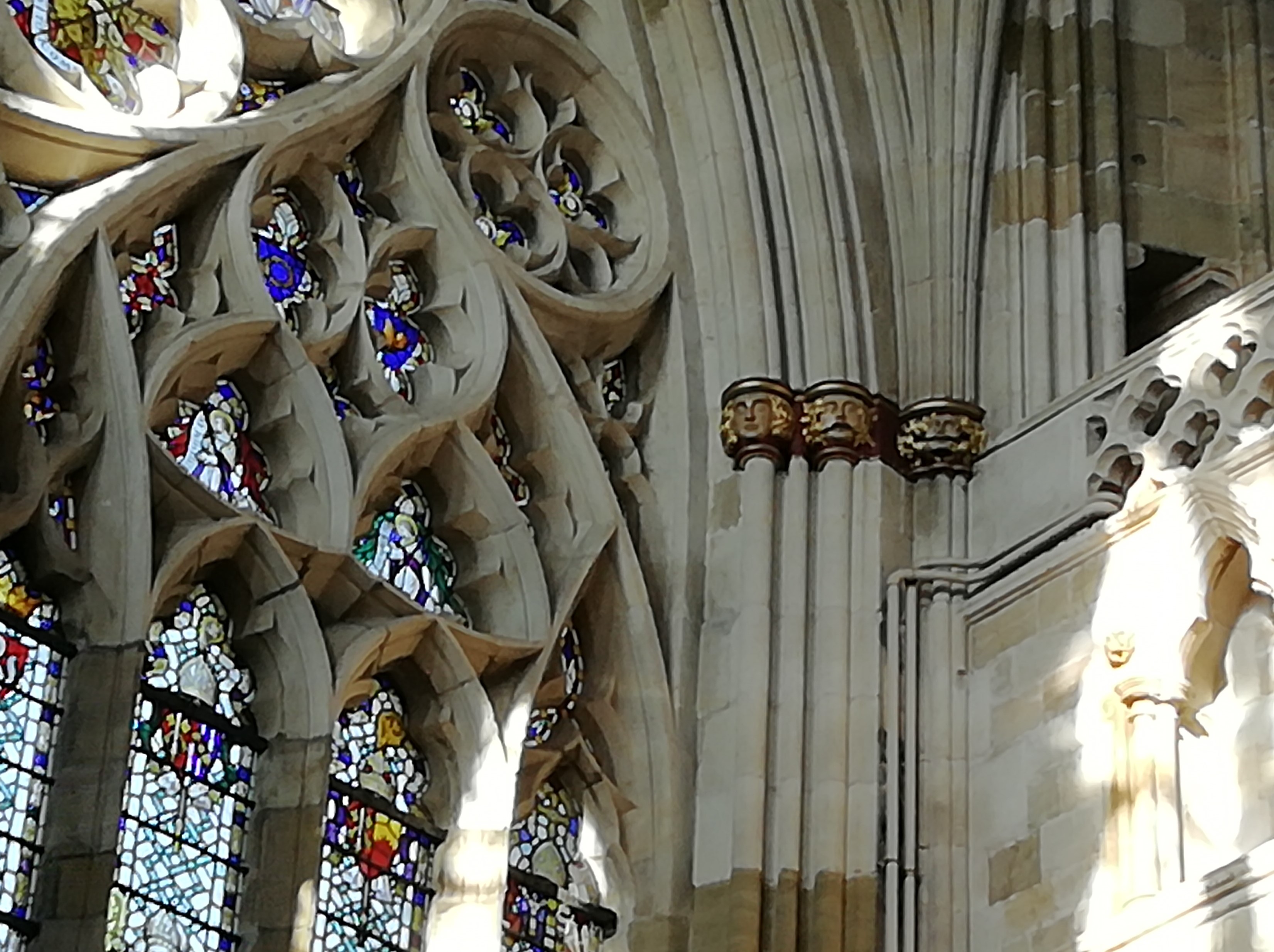
<p>Exeter Cathedral in Devon, England, has more than 50 green man carvings.<sup id="fnref:1" role="doc-noteref"><a href="#fn:1" class="footnote" rel="footnote">1</a></sup> The oldest are at the cathedral’s east end, but my interest was particularly caught by a trio of capital carvings on the Great West Window, just by the visitor entrance.</p>

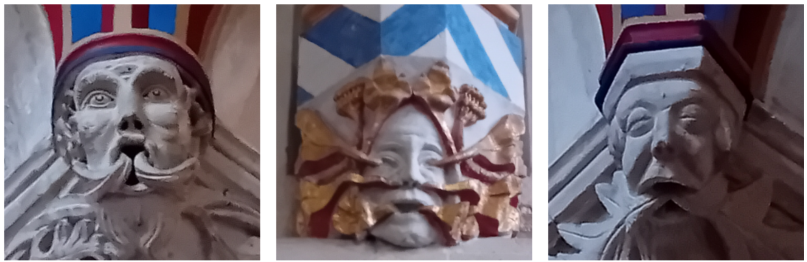
<p><img src="/assets/greenman/GreenManTriptych.png" alt="Green man triptych" /></p>

<p>I hope to return one day and take a better photo. But even on this image quality, I think this is clearly a sequence of three carvings, showing a plain face, then the foliage starting to grow, then the foliage much grown. The facial features look the same in all three carvings, and the middle carving matches the left carving’s straight blond hair on the fringe.</p>

<p>I have started looking for other examples of medieval green man sequences, but so far I haven’t found any. This is not to say they don’t exist; maybe I am looking in the wrong places. Or maybe green men tend to be recorded individually rather than with their neighbours. I am reminded of <a href="https://www.goodreads.com/book/show/102920.Understanding_Comics">Scott McCloud’s nonfiction comic about comics</a>:</p>

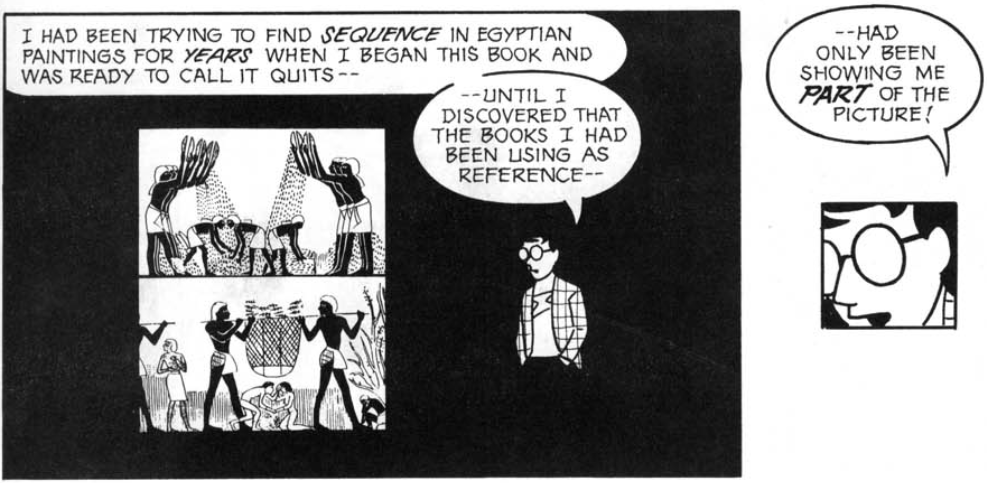
<p><img src="/assets/greenman/McCloudEgyptianComics.png" alt="Comic panels of Egyptian Art and then author saying he was shown only part of the picture" /></p>

<p>It turns out these ancient Egyptian drawings were part of a sequence, much like the Bayeux tapestry. McCloud defines comics as ‘sequential art’, however short, and the Exeter green man triptych would qualify.</p>

<p><img src="/assets/greenman/GreatWestWindow.jpg" alt="Green man triptych next to the Great West Window" /></p>

<p><em>The green man triptych next to the Great West Window. The capitals on the left side of the window (not shown here) seem to be a fight between two animals, a face surrounded by foliage, and a face with curly blond hair – perhaps the same character as on the right, but less obviously in sequence.</em></p>

<p>Incidentally, while I am on the topic of green men in Devon, there are several websites that claim Ottery St Mary Church – which is designed like a mini Exeter Cathedral – contains two medieval green men carvings. It actually contains three. Two are in the North Aisle; one is in the Lady Chapel.</p>

<p><img src="/assets/greenman/OtteryStMaryGreenMen.png" alt="Three green men" /></p>

<hr />

<div class="footnotes" role="doc-endnotes">
  <ol>
    <li id="fn:1" role="doc-endnote">
      <p>Keith Barker (2009) <em>The Green Men of Exeter Cathedral</em> gives a spotter’s guide to 54 green men – not including faces that are merely <em>surrounded</em> by vegetation. I can’t remember how I first found out about this book, since I can no longer find a reference to it anywhere. As far as I know, it’s only available by appointment at the cathedral library. I hope it is made more widely available, such as in the cathedral shop, as it is a useful pamphlet, and the cathedral guides and stewards apparently receive hundreds of enquiries about green men each year. ‘The interest seems to be particularly strong among American guests.’ (page 4) <a href="#fnref:1" class="reversefootnote" role="doc-backlink">&#8617;</a></p>
    </li>
  </ol>
</div>]]></content><author><name>John Holden</name></author><summary type="html"><![CDATA[The Green Man – known before 1939 by the perhaps better name of ‘foliate head’ or ‘foliate mask’ – is a medieval motif of foliage growing from a face. Typically the foliage is disgorged from a human face’s mouth, but sometimes it comes from other facial features, or from animals and other creatures.]]></summary></entry><entry><title type="html">On Designing Mnemonic Systems – and Why Picture Notation is the Best Mnemonic Code for Chess</title><link href="https://johnden.org/theoryofmnemonics" rel="alternate" type="text/html" title="On Designing Mnemonic Systems – and Why Picture Notation is the Best Mnemonic Code for Chess" /><published>2023-12-16T00:00:00+00:00</published><updated>2023-12-16T00:00:00+00:00</updated><id>https://johnden.org/mnemonictheory</id><content type="html" xml:base="https://johnden.org/theoryofmnemonics"><![CDATA[<div style="display: flex; align-items: flex-start; gap: 20px; flex-wrap: wrap; margin: 20px 0;">

  <img src="/assets/homepage/ChessCover4.png" alt="The Chess Memory Palace cover" style="width: 230px; height: auto; display: block;" />

  <div style="width: 420px; max-width: 100%;">

    <a href="https://johnden.org/chessmemorypalace" style="display: block; background-color: #2e7d32; color: #ffffff; padding: 14px; text-decoration: none; font-weight: bold; border-radius: 6px; margin-bottom: 10px; text-align: center;">
      📖 Read Free Sample (Chapters 1–3)
    </a>

    <a href="https://amzn.to/4k7nXBO" style="display: block; background-color: #ff9900; color: #000000; padding: 14px; text-decoration: none; font-weight: bold; border-radius: 6px; margin-bottom: 10px; text-align: center;">
      🛒 Buy Paperback on Amazon
    </a>

    <a href="https://chessmemorypalace.etsy.com" style="display: block; background-color: #f1641e; color: #ffffff; padding: 14px; text-decoration: none; font-weight: bold; border-radius: 6px; margin-bottom: 10px; text-align: center;">
      📱 Buy eBook on Etsy
    </a>

    <a href="https://www.youtube.com/@ChessMemoryPalace" style="display: block; background-color: #cc0000; color: #ffffff; padding: 14px; text-decoration: none; font-weight: bold; border-radius: 6px; text-align: center;">
      ▶️ Watch Video Tutorials on YouTube
    </a>

  </div>

</div>

<!-- <p style="font-size: 0.9em; color: gray;">
  Amazon links are affiliate links — this gives me a little bit more for each sale, at no cost to you. I earn from qualifying purchases.
</p>
 -->

<p>Memory palaces are a powerful tool to expand your memory. However, it’s not always obvious how to apply them. One of the common questions is, “I have [some complicated dataset]. How do I memorise it?”</p>

<p>I don’t claim to be an expert, but I have built quite a few memory palaces for exams, and in particular I have spent a long time pondering the best mnemonic system for chess. In this article I want to share where my thinking has reached, on the main points to consider when designing a mnemonic system.</p>

<p>This will also explain why I believe my book <a href="/chessmemorypalace">The Chess Memory Palace</a>, with its mnemonic code of <a href="/chessmemorypalace/chapter1">picture notation</a>, is the best mnemonic system for chess, as mnemonists sometimes challenge the book on this point.</p>

<p><strong>The essence of mnemonic systems is two steps:</strong> (1) work out the structure of your system of pegs, then (2) build a reliable code to convert non-memorable data into memorable data.</p>

<p>In this article, I have most to say about step 2. But we will begin with step 1, because sometimes the structure of the pegs will give you constraints in the way you can design the mnemonic code. Finally we will touch briefly on error detection and redundancy.</p>

<p>This is a relatively technical post. It will make most sense if you have some familiarity with the challenges of using mnemonics. My extended example of a mnemonic code (step 2) is <a href="/chessmemorypalace/chapter1">picture notation for chess</a>, so I recommend reading that first – but you should still be able to follow, even if you don’t know picture notation. (For simplicity, my chess examples will start from move 1, e.g. 1.e4 e5, but note that I don’t recommend you begin your chess memory palaces at move 1.)</p>

<table>
  <thead>
    <tr>
      <th style="text-align: left">#</th>
      <th style="text-align: left">Section</th>
    </tr>
  </thead>
  <tbody>
    <tr>
      <td style="text-align: left">1</td>
      <td style="text-align: left"><a href="#fundamentals">Fundamentals of mnemonic theory</a></td>
    </tr>
    <tr>
      <td style="text-align: left">2</td>
      <td style="text-align: left"><a href="#nonlinear">Non-linear memory palaces</a></td>
    </tr>
    <tr>
      <td style="text-align: left">3</td>
      <td style="text-align: left"><a href="#codes">Mnemonic codes</a></td>
    </tr>
    <tr>
      <td style="text-align: left">4</td>
      <td style="text-align: left"><a href="#chess">Mnemonic code for chess moves: the specifications</a></td>
    </tr>
    <tr>
      <td style="text-align: left">5</td>
      <td style="text-align: left"><a href="#picturenotation">How picture notation meets these specifications, and why PAO and alternatives do not</a></td>
    </tr>
    <tr>
      <td style="text-align: left">6</td>
      <td style="text-align: left"><a href="#redundancy">A word on error detection and redundancy</a></td>
    </tr>
    <tr>
      <td style="text-align: left">7</td>
      <td style="text-align: left"><a href="#analysisparalysis">Analysis paralysis</a></td>
    </tr>
  </tbody>
</table>

<h3 id="-fundamentals-of-mnemonic-theory"><a name="fundamentals"></a> Fundamentals of mnemonic theory</h3>
<p>The rule of step 1 is: <strong>All mnemonics are about mapping something that you don’t know onto something that you do know.</strong> For example, you might not know the order of the planets, but you do know a series of landmarks in your street. You can then imagine the planets (or something that reminds you of the planets, e.g. a red warlike figure for Mars) in order along your street, creating visualisations (little stories) to associate one planet with one location, in order. (Do not get hung up on the word “visualisation” – people have different internal experiences, and even many people with aphantasia can build memory palaces. For most people, as long as you can remember stories and where they took place, it should be possible.)</p>

<p>The “things that you do know” structure the memories, so that you have a way of navigating through the entire dataset. In this case, you can mentally walk along your street from landmark to landmark, and recall the planet attached to each. The “things that you do know” are often called “pegs”. Traditionally they are locations, hence the names “memory palace”, “method of loci” or “journey method”, but they don’t have to be locations; they can be anything you know well, e.g. song lyrics, film scenes, football players in order of shirt number. (Joe Reddington in <a href="https://www.goodreads.com/book/show/59897651-advanced-memory-palaces">Advanced Memory Palaces</a> notes the method of loci can be thought of as just “an array that is indexed by physical locations”, and the term is shorthand for “using physical locations a a source of keywords for an array”. Although, my vague understanding of the science is that there <em>is</em> something special about using locations rather than objects for pegs, as our brains remember the place where we learned something, and our neurons that store locations trigger slightly <em>before</em> we have the conscious knowledge of remembering the information.)</p>

<h3 id="-non-linear-memory-palaces"><a name="nonlinear"></a> Non-linear memory palaces</h3>
<p>Usually designing step 1, the system of pegs, is not too difficult. The vast majority of memory palaces I have read about are linear arrays, so you can use any linear journey of landmarks, film scenes, song lyrics etc.</p>

<p>How about <em>tabular</em> data (that has rows and columns)? One method is to use have a series of similarly-structured pegs (for the table rows) where you can attach the different data points (values, in the table columns) in a consistent way. For example, use five shops in a high street for five rows of data. Attach the data in column 1 to the doors, the data in column 2 to the windows. (This, alongside Karnaugh Maps (like Venn Diagrams) and binary trees, is discussed in <a href="https://www.goodreads.com/book/show/59897651-advanced-memory-palaces">Advanced Memory Palaces</a>, and something similar for preparing to remember details about individuals in <a href="https://www.goodreads.com/en/book/show/6346975">Moonwalking with Einstein</a>.)</p>

<p>For chess, there is a challenge: chess openings take a <em>branching tree structure</em> (technically a <em>directed graph</em> when there are transpositions involved), so it is natural for the systems of pegs to also take a tree structure.</p>

<p>(As Joe Reddington pointed out to me in correspondence, the peg system for branching data doesn’t <em>necessarily</em> have to take a branching structure itself. An example would be, imagine you wanted to memorise an algorithm to win <a href="https://rosettacode.org/wiki/21_game">21</a>. You could memorise a big branching tree, or you could just memorise three pairs: “when my opponent says 1, I say 3”; “when my opponent says 2, I say 2”, “When my opponent says 3, I say 1”. This is obviously a toy example that doesn’t require a memory palace at all, but it shows the point that sometimes you can memorise a simple lookup table to navigate branching real-life data. This doesn’t work for chess, because move order matters, and you don’t always respond to the same move in the same way; it depends on the overall board position. Another approach would be to use computer science techniques to convert the branching data into a linear shape, but I haven’t yet found a satisfactory way to do this for an unbalanced tree like a chess opening.)</p>

<p>So how can we build a branching system of pegs? One correspondent on the Art of Memory Forum maps chess moves to branching family trees. This is ingenious but I think limited. It seems to me more versatile to use locations with branching paths. A figure from The Chess Memory Palace:</p>

<p><img src="/assets/chessmemorypalace/f3-2.png" alt="Branching map diagram" /></p>

<p>In my view this is actually a more natural way to use locations than a linear memory palace. In our experience of the world, most of our locational knowledge is as a network of places. For example, if I want to find a plate in my flat, I would enter the flat, go straight on to the kitchen, turn right to the cupboard. If I wanted to use the oven, I would enter the flat, go straight on to the kitchen, turn left to the oven. If I wanted to access the bookshelves, I would enter the flat, turn left to the living room, go to the far side of the room for the books, etc. My experience of my flat isn’t a linear journey hugging the edge of each room; it is more like a network of nodes. The same is true of my workplace, university campus, local town centre, etc.</p>

<p>In this way, you can use memory palaces to store branching data (or graphs with loops, or flowcharts). It does make less ‘efficient’ use of space than a linear memory palace, because you can’t fit too many locations in a room without the branching paths getting confused. But in practice I haven’t needed to worry about running out of settings. If you need more settings, you can always go and explore a new town, or play a new video game!</p>

<p>Whatever system of pegs you use, make sure you have a systematic method to walk through the entire thing (assuming your goal is to be able to reproduce all the information without external prompting). Despite what I have said above about trees, if possible I do think it is best to convert your data into a simple linear array. So, for example, <a href="https://www.supermemo.com/en/blog/twenty-rules-of-formulating-knowledge">never try to memorise an unordered set</a>. Give it an order, even if the order is arbitrary.</p>

<p>Before we move to step 2 (the mnemonic code), we first we need to ask, does the design of pegs create any constraints on the mnemonic code? In the case of chess, the answer is yes. We want the memory palace to be able to branch after any pair of moves. Therefore each location (peg) can hold a maximum of one pair of moves.</p>

<h3 id="-mnemonic-codes"><a name="codes"></a> Mnemonic codes</h3>
<p>The rule of step 2 is: <strong>All mnemonics are about converting non-memorable data into memorable data</strong>. This means something that is easy to visualise, animate, and describe in stories: typically people and animals and emotive objects.</p>

<p>In the easiest cases, you don’t need a code at all, you can just visualise your target information directly. The classical example is memorising a shopping list. (I used to think this is a silly example because you can just write down a list, until one day my friend verbally gave me a list of ingredients to find while we entered a supermarket.) With a shopping list, you can just memorise the items themselves, with a bit of exagerration, such as eggs cracking, brocolli growing through the floor like trees, orange juice spilling over the shelves, etc.</p>

<p>In other cases, you can memorise one thing in place of another, but you don’t need a rigorous code. For example, for <em>courage</em>, imagine Mars or Achilles (The <em>Dialexeis</em> fragment, ~400 BC); for <em>the Earl of Balfour</em>, imagine a ‘ball 4’ pool ball (<a href="https://www.goodreads.com/en/book/show/5149957">Ed Cooke</a>), for <em>Buchanan</em>, imagine a cannon firing (my exam prep a few years ago).</p>

<p>The most difficult cases are truly abstract data, when you will need to design a rigorous code (and rote memorise it). The best known example is the <em>major sytem</em> for memorising numbers. The digits 0-9 are encoded onto consonent sounds, so that you can memorise words instead of numbers. For example, <em>turtle bench lime</em> encodes the first nine decimal places of pi (141592653). (I won’t explain the details here, it is <a href="https://artofmemory.com/blog/major-system/">easy to search</a>.) Early versions of the major system date back to the 16th century. The practice of converting numerals to sounds for memorisation dates back at least as far as the Kaṭapayādi system in India, around 600 AD.</p>

<p>Memory world records have been slashed in the last 20 years. A lot of this has been due to the development of more efficient mnemonic codes. For example, using a version of the major system, you could memorise a deck of playing cards in 52 pictures (one picture per card). Ben Pridmore’s Ben system was revolutionary, as he created a way to memorise a pair of cards in a single picture, so now you can memorise a deck of cards in 26 pictures – at the cost of preparing pictures for 2704 possible combinations upfront. Another development noticed that you can use the pegs to encode information – e.g. use the same peg twice if the pair of cards starts with a red, move to a new peg if the pair of cards starts with a black. This halved the number of combinations to memorise upfront, to 1352.</p>

<p>A very popular mnemonic code for random digits is known as PAO: Person Action Object. In a 2-digit system, you would memorise 100 people, each with an action and an object. e.g. 15 might be Albert Einstein writing on a blackboard. 36 might be Michael Jackson moonwalking with a white glove. Then each set of 6 random digits can be converted into an image: e.g. 15-36-15 might be Albert Einstein moonwalking with a blackboard. (Hence the name of the most famous memory book, <em>Moonwalking with Einstein</em>.) In a 3-digit system, you would memorise 1000 people, each with an action and object. This is very powerful, as you can memorise 9 digits in a single composite image of 3 picture elements – but it carries the high upfront cost of preparing and memorising pictures of 1000 people, actions and objects. (Some people use 1000 people and objects but only 100 actions, to code 8 digits at a time.)</p>

<h3 id="-mnemonic-code-for-chess-moves-the-specifications"><a name="chess"></a> Mnemonic code for chess moves: the specifications</h3>
<p>How does this apply to chess? The first thing to note is that fewer images is better. If you can memorise 9 digits in a single composite image, that’s more efficient than memorising 6 digits in a composite image. For chess, we have seen from the peg structure that we want to memorise a maximum of one pair of moves (e.g. e4 e5) in a single image, because the palace may need to branch after any pair of moves. So, ideally, we want to memorise this in a single image, or one image for each of the half-moves.</p>

<p>The second thing to note is that memory competitors need to do lots of work to memorise their images upfront, because they need to convert data to pictures in their heads. For example, when they see 15, they need to immediately know that is coded as Albert Einstein, so that they can quickly memorise it under memory tournament conditions. (In other words, they need their mnemonic system to be ‘bidirectional’ (<a href="https://youtu.be/ogtVQ48VgC4">Anthony Metivier</a>).) In chess this is different: we can memorise our opening repertoires at leisure at home. I don’t need to convert e.g. Nf3 from a chess move into a mnemonic picture in my head: I can just look up the code <a href="/chessmemorypalace/appendix">in the appendix</a>. All I need to do at the board is convert a mnemonic picture back into a chess move. So, we need a system that is easy to convert a picture to a chess move, but it does not need to be easy to convert a chess move into a picture in our heads. So, we don’t need to make compromises in order to minimise the number of picture words in the system.</p>

<p>Third, and this is very important (although I began to understand it more fully only after I had published), memory competitors are memorising uniformly distributed random data. Each of their image combinations will come up with roughly equal frequency. “<em>PAO works at its best when the information to memorise is uniformly distributed. i.e. 100 rolls of a single dice. When the same Ps, As, or Os turn up a lot, you get very likely to make mistakes (‘Einstein is moonwalking with a banana, now Einstein is moonwalking with a Lego, now Trump is moonwalking with a banana’) […] In general, I’d go as far as to say that PAO is a poor choice for</em> any <em>structured data</em>” (<a href="https://forum.artofmemory.com/t/picture-notation-a-mnemonic-system-for-chess/70514/61">Joe Reddington</a>) (It would be interesting to see a memory competition where the random digits are not uniformly distributed, but were heavily weighted towards certain digits – would competitors need to adapt their techniques?) With chess openings, the data is not at all randomly or uniformly distributed. There are many more moves to the central squares than the squares round the edge of the board. So, we want a system where we have sufficient variation in the pictures we use, despite the same target squares turning up repeatedly.</p>

<h3 id="-how-picture-notation-meets-these-specifications-and-why-pao-and-alternatives-do-not"><a name="picturenotation"></a> How picture notation meets these specifications, and why PAO and alternatives do not</h3>
<p>Picture notation codes every chess move (except for obscure things like underpromotions) in a single picture word. For example, in the starting position, <em>shampoo</em> means 1.f3, because the <em>sh</em> and <em>m</em> code the f3 square, and the number of syllables (2) codes the second candidate pieces (the pawn – the knight would have been the first candidate piece, because it’s on the back rank). This means any pair of moves can be shown in a single composite image of two picture words, e.g. “<em>shampoo</em> pouring over a <em>judge</em>” could be 1.f3 Nf6.</p>

<p>This is, I think, the most efficient way to encode a pair of moves. The most obvious solution is to encode both the starting and target square of each move, e.g. 1.f3 Nf6 becomes 6263 7866 (i.e. International Correspondence Chess Federation numeric notation). But memorising the starting square is overkill; there is usually a maximum of four candidate pieces that can move to the target square, so you only need to identify it on a scale of 1-4, not the 1-64 squares of the chessboard.</p>

<p>The second obvious solution is to use algebraic notation, e.g. memorise that the piece to move is a knight or a pawn. The problem with this is the edge cases where two of the same piece can move to the same square. You’d need another system to deal with these tiebreaks. This can be done using the digits 1-9 (king, queen, left rook, right rook, bishop, left knight, right knight, left pawn, right pawn) – but this is more than double picture notation’s candidate piece scale (thus limiting the picture words you can use) and undermines the purpose of using the ‘more intuitive’ algebraic notation as the basis of the mnemonic code.</p>

<p>The third obvious solution is not to bother memorising the piece that moves. This is the most common solution I have seen proposed online. e.g. if you memorise the target squares e4 e5 f3 c6, any chess player will recognise that the moves are 1.e4 e5 2.Nf3 Nc6. I have seen this justified as “you don’t <em>need</em> to memorise which piece moves” (not quoting anyone in particular). The drawback of this, of course, is that it leaves ambiguities. The piece to move isn’t always obvious. And the justification is a misunderstanding. <em>If</em> you had to memorise a more complicated image in order to memorise the candidate piece, I would agree it might be worth the compromise of not memorising the candidate piece. But, <strong>we are not trying to minimise the total information memorised. We are trying to minimise the total number of images (and elements within the images)</strong>. Picture notation uses the number of syllables within the picture word to identify the candidate piece, so it does not increase the number of images to memorise. Identifying the candidate piece with syllables is costless. (Costless in terms of memory space. There is a slight cost in reducing your set of available picture words to choose from. But there are still <a href="/chessmemorypalace/appendix">lots of options</a>.)</p>

<p>Mnemonists naturally want to apply PAO. This hides a couple of difficulties. First, <em>how exactly</em> PAO, a digit system, will unambiguously code chess moves. It is possible to use PAO to code a pair of chess moves – but to my mind, this is 50% worse than using picture notation, because picture notation needs only two elements in each composite image, not three. (This also means that picture notation can easily be decoded (from image to chess move) one half-move at a time, which is simpler at the board than decoding both P and A, then A and O, to recover the two half-moves.) Second, because of the non-random nature of chess moves, you will end up with lots of the same Ps, As and Os, which is hard to memorise. Picture notation solves this problem in two ways: (1) each square can take several picture words, depending on the candidate piece. e.g. d4 will somtimes be <em>roar</em>, sometimes <em>robber</em>, and occasionally <em>warrior</em> or <em>barbarian</em>. (2) If you are seeing one picture word too often, you can always substitute an equivalent, e.g. <em>briar</em> or <em>wrapper</em> instead of <em>robber</em>.</p>

<p>Another suggestion I have seen in correspondence is to just have 64 base images, and transform the images to indicate the candidate piece. e.g. a <em>pearl</em> is d5 with the first candidate piece, a <em>pearl on fire</em> is d5 with the second candidate piece, a <em>pearl covered in oil</em> is d5 with the third candidate piece, etc. This works in theory, in fact I suggest it in the section on <em>Picture notation in other languages</em> in Chapter 7 – but only if there is no other solution, such as syllables, tone sounds, or grammatical gender. This system needs four elements in each composite image instead of two – with correspondingly more interactions – and also runs into the problem of trying to memorise lots of similar images. Remember, we can build our memory palaces at home with full use of the appendix, so there is no fixed cost of memorising all the picture words upfront, unlike memory competitors memorising digits and decks of cards.</p>

<p>The final advantage of picture notation is that it is easy to share with others, unlike PAO. But this isn’t the reason I designed it this way.</p>

<p>There are probably lots of ways to design a mnemonic code for chess that keeps 1 picture = 1 half-move, so it is possible to come up with systems that are equally as good as picture notation – but for all the reasons set out in this blog post, I don’t think it is possible to make a system that is <em>better</em>. One alternative is to count letters rather than syllables, but this requires you to spell words accurately in your head, which is harder. The only way I can think of to improve picture notation would be to code two half-moves in a single picture – but this would require six items of information in a single picture (two target files, two target ranks, two candidate pieces), which I don’t believe will be possible. It’s also not necessarily an improvement, because at the board it can be easier to decode one half-move at at time. (An exception might be to create some images for common move-pairs. For example, <em>roar</em> <em>roar</em> is fairly common; you could systematically replace this with a new single image.)</p>

<h3 id="-a-word-on-error-detection-and-redundancy"><a name="redundancy"></a> A word on error detection and redundancy</h3>
<p>Finally, a note on error detection and correction. Some mnemonists, when memorising data for the medium to long term, will overlap some of their images, so that some digits are memorised twice (e.g. <a href="https://youtu.be/vdomZWQvy-U?feature=shared&amp;t=225">Nelson Dellis</a>). This helps catch errors, and offers a hint if they remember one image but not the next. (You could also come up with <a href="https://en.wikipedia.org/wiki/Checksum">checksums</a> if you are able or don’t need to do the calculations in your head. If I ever memorise something critical, I will definitely include lots of extra error correction images, or just memorise the whole thing twice with different pictures. One of the interesting but rarely applicable properties of mnemonics, compared with rote-learning raw facts, is that it makes “memorise it twice” possible as a concept.)</p>

<p>Similarly, one piece of advice recommended since ancient times is to have a door or window every five or ten locations along your memory palace. This is excellent advice if you are designing a traditional linear memory palace, as it chunks your memories into digestible groups of five, and acts as a safety mechanism to alert you if you forget a location. Both techniques can be useful, but are unnecessary for chess, because the board position itself will validate or invalidate your moves. (I discuss several reasons why The Chess Memory Palace doesn’t use the doors and windows idea in <a href="/chessmemorypalace/notes">Note 5 to Chapter 3</a>.)</p>

<p><img src="/assets/chessmemorypalace/f2-1.png" alt="Robust composite images diagram" /></p>

<p>The diagram above hasn’t attracted any comment, but it is my favourite diagram in the book. The ideas are not new; they are based on techniques memory competitors use to store two pictures together in a location without getting the order confused. But formalising it like this helped me memorise images more consistently. The point I want to emphasise here is that I recommend visualising all three interactions, not just two, and that we have dual indicators of picture word order: active versus passive roles and higher versus lower position. These are forms of <em>redundancy</em> (another term I picked up from <a href="https://www.goodreads.com/book/show/59897651-advanced-memory-palaces">Advanced Memory Palaces</a>).</p>

<p>In theory, you would only need to visualise two of the three interactions to be able to recover both picture words, and in theory you only need a single rule to remind you which picture word is first and which is second. But this makes your memory less robust: if you have any lapse in memory, the information is lost. By having redundancy, you should still be able to recover 100% of the information, even if you start to forget details, e.g. you forget one of the three interactions, or you remember which picture word is higher but forget which is doing the action to the other.</p>

<p>When designing rules to store data in a memory palace, there is a trade-off between writing strict rules with added redundancy, versus leaving room for creative images. There is also a trade-off between spending time visualising detailed images in the first place, versus spending time reviewing and rebuilding broken links later. In general, the more you want to memorise, and the longer the time period over which you want to retain the memories, the more you should come down on the first side of both of these trade-offs. The Chess Memory Palace method needs to work for large quantities of chess moves over a long playing career, hence I advise detailed images and lots of redundancy.</p>

<p>When designing your own mnemonic systems, consider where you want to land on these trade-offs. Do you want special markers every five/ten pegs, strict rules for the images, and memorise extra images for error detection/correction, or is it not worth it?</p>

<h3 id="-analysis-paralysis"><a name="analysisparalysis"></a> Analysis paralysis</h3>
<p>Having written a 4000 word essay, it’s still important to <em>not overthink it</em>. Sometimes you just need to start, and you will work out the problems as you go along. My early versions of picture notation used picture transformations, vowel sounds and a complicated piece-priority system to choose the candidate piece. I only simplified it over time, and particularly when writing the book, as explaining a system forces you to iron out any unnecessary complications. (This also meant that I had a bunch of old chess memory palaces in my mind that used outdated technology, which I have gradually let decay, apart from a few annoyingly persistent images. This is how I can say with confidence that “your best images will remain with you effortlessly for a decade” (page 145)).</p>

<p>So, it’s worth designing the best system you can upfront, and I hope this blog post will be helpful in that endeavour. But don’t get too bogged down: the best system is the system you will actually use.</p>]]></content><author><name>John Holden</name></author><summary type="html"><![CDATA[📖 Read Free Sample (Chapters 1–3) 🛒 Buy Paperback on Amazon 📱 Buy eBook on Etsy ▶️ Watch Video Tutorials on YouTube]]></summary></entry><entry><title type="html">Cinematically Showing a Change of Mind</title><link href="https://johnden.org/changeofmind" rel="alternate" type="text/html" title="Cinematically Showing a Change of Mind" /><published>2023-12-09T00:00:00+00:00</published><updated>2023-12-09T00:00:00+00:00</updated><id>https://johnden.org/changeofmind</id><content type="html" xml:base="https://johnden.org/changeofmind"><![CDATA[<p><strong>Article contains moving image with flashing lights</strong></p>

<p>I recently came across the same situation in TV and YouTube, and found it instructive to see how it was handled. The situation is this: someone is adamant that they won’t do something. In the next scene, they are doing it.</p>

<p>The unexpected contrast creates a funny moment (which is of course completely lost when analysing it like this).</p>

<p>First, from Amazon TV show <a href="https://www.amazon.co.uk/Colombia-Special-Part-1/dp/B086VZ8X4M">The Grand Tour</a>.</p>

<p><img src="/assets/changeofmind/hammond-transition-small.gif" alt="Hammond refusing then sitting in his car" /></p>

<p><em>“No I’m not,” / “Right, here we go…”</em></p>

<p>In scene 1, car enthusiast Richard Hammond is adamant that he will not drive his monster truck into a ditch. There is then a marked scene transition. Rather than a straight cut, the next clip arrives with a kind of wipe transition from left to right, and a ‘whooshing’ noise. In scene 2, he is now in the car, about to drive forward. (The wipe itself appears to be about 1/2 a second of an image of a hedge, going from left to right, before scene 2 appears. The image of scene 2 itself does not slide in from the left. There is also a nice rhythm to Hammond’s speech and driving.)</p>

<p>Compare this with YouTuber Ryan Trahan, in his excellent <a href="https://youtu.be/mufeRQYgqZc?feature=shared&amp;t=158">metaverse video</a>.</p>

<p><img src="/assets/changeofmind/trahan-transition-small.gif" alt="Ryan's face followed by stormtrooper costume" /></p>

<p><em>“I have a mission here. I’m not going to play around and act like I’m a storm–” / [dance music]</em></p>

<p>In scene 1, with a view of Ryan’s head, there is a voiceover announcing how serious he is, and that he isn’t going to play around. He then <em>interrupts the sentence</em> halfway through a word to cut to scene 2 with the dancing and music.</p>

<p>Both these transitions are very effective, and tailored to their medium of TV/YouTube. On TV, cutting halfway through a word would be too fast and just look like a mistake. While on YouTube, the wipe transition could work, but interrupting the sentence is quicker and funnier.</p>

<p>Both videos drew attention to the cut between scenes. This highlights the contrast to increase the humour. It also helps the audience realise that the story isn’t continuing linearly, so that we understand the switch in direction.</p>]]></content><author><name>John Holden</name></author><summary type="html"><![CDATA[Article contains moving image with flashing lights]]></summary></entry><entry><title type="html">A hospital packing list</title><link href="https://johnden.org/hospitalpackinglist" rel="alternate" type="text/html" title="A hospital packing list" /><published>2023-11-19T00:00:00+00:00</published><updated>2023-11-19T00:00:00+00:00</updated><id>https://johnden.org/hospitalpackinglist</id><content type="html" xml:base="https://johnden.org/hospitalpackinglist"><![CDATA[<p>The last couple of times I have been in hospital or visited others in hospital, I have compiled notes on the most useful items to have at your bedside.</p>

<ol>
  <li><strong>Paper cups</strong>. Useful for holding small quantities of liquid so you don’t risk spilling an entire bottle. Also useful to spit into, hold rubbish, etc. Bring lots, so you can use them freely without worrying about running out.</li>
  <li><strong>Straws (with a bend)</strong>. Require less dexterity to drink from.</li>
  <li><strong>Bottles of water</strong> and the healthiest <strong>snack bars</strong> you can find, so you don’t have to call the nurses for refreshments repeatedly.</li>
  <li><strong>Small plasters</strong>, for any scrapes.</li>
  <li><strong>Tissues and wetwipes</strong>, to keep clean.</li>
  <li><strong>Notebook and pen</strong>. Write down questions for the doctors or you will forget to ask, and write down their answers or you will forget what they said. Also to make notes on phone calls, e.g. if you are using travel insurance.</li>
  <li><strong>Wireless headphones</strong>. The bed (and perhaps the patient) is likely to have various wires and tubes attached; you don’t want to get tangled with wired headphones.</li>
  <li><strong>Long charging cable</strong>, so you can charge your phone even if the plug socket is a distance away.</li>
  <li><strong>Slippers</strong>, to make it easy to get up.</li>
  <li><strong>Plastic bags</strong>, to hold your items if you need to migrate to another room, or just to keep your stuff in one place on the bed. Bring the quiet kind, not the kind that rustle loudly.</li>
</ol>

<p>If you are going to hospital as a birth partner, you should also bring a <strong>digital watch</strong>. There are all kinds of things you might need to time during labour and after birth.</p>]]></content><author><name>John Holden</name></author><summary type="html"><![CDATA[The last couple of times I have been in hospital or visited others in hospital, I have compiled notes on the most useful items to have at your bedside.]]></summary></entry><entry><title type="html">Why memorise chess opening theory (with a memory palace)?</title><link href="https://johnden.org/whymemoriseopenings" rel="alternate" type="text/html" title="Why memorise chess opening theory (with a memory palace)?" /><published>2023-11-18T00:00:00+00:00</published><updated>2023-11-18T00:00:00+00:00</updated><id>https://johnden.org/whymemoriseopenings</id><content type="html" xml:base="https://johnden.org/whymemoriseopenings"><![CDATA[<div style="display: flex; align-items: flex-start; gap: 20px; flex-wrap: wrap; margin: 20px 0;">

  <img src="/assets/homepage/ChessCover4.png" alt="The Chess Memory Palace cover" style="width: 230px; height: auto; display: block;" />

  <div style="width: 420px; max-width: 100%;">

    <a href="https://johnden.org/chessmemorypalace" style="display: block; background-color: #2e7d32; color: #ffffff; padding: 14px; text-decoration: none; font-weight: bold; border-radius: 6px; margin-bottom: 10px; text-align: center;">
      📖 Read Free Sample (Chapters 1–3)
    </a>

    <a href="https://amzn.to/4k7nXBO" style="display: block; background-color: #ff9900; color: #000000; padding: 14px; text-decoration: none; font-weight: bold; border-radius: 6px; margin-bottom: 10px; text-align: center;">
      🛒 Buy Paperback on Amazon
    </a>

    <a href="https://chessmemorypalace.etsy.com" style="display: block; background-color: #f1641e; color: #ffffff; padding: 14px; text-decoration: none; font-weight: bold; border-radius: 6px; margin-bottom: 10px; text-align: center;">
      📱 Buy eBook on Etsy
    </a>

    <a href="https://www.youtube.com/@ChessMemoryPalace" style="display: block; background-color: #cc0000; color: #ffffff; padding: 14px; text-decoration: none; font-weight: bold; border-radius: 6px; text-align: center;">
      ▶️ Watch Video Tutorials on YouTube
    </a>

  </div>

</div>

<!-- <p style="font-size: 0.9em; color: gray;">
  Amazon links are affiliate links — this gives me a little bit more for each sale, at no cost to you. I earn from qualifying purchases.
</p>
 -->

<blockquote>
  <p>I’ve done the analysis with my engine, and I’ve organised everything, and I understand it and I get it – I just can’t remember it.</p>

  <p>GM Patrick Wolff<sup id="fnref:0" role="doc-noteref"><a href="#fn:0" class="footnote" rel="footnote">1</a></sup></p>
</blockquote>

<p>Last year I published <a href="https://smile.amazon.com/dp/B0BR9DQMVS">The Chess Memory Palace</a>, a guide to using memory techniques to memorise a chess opening repertoire.</p>

<p>I have read some discussion doubting whether it is useful for a chess player to memorise moves. For the most part, I am not too worried by this question. I am content to say that <em>if</em> you want to memorise a chess opening repertoire, this is the way to do it. If you don’t, then this is not the book for you.</p>

<p>But I am also a bit surprised by the question. It seems to be a fact that both professionals and amateurs do, in fact, spend significant time memorising moves, yet often complain of forgetting. And I know from my own club-level experience that I get better results (and enjoy the game more) when I recall my opening prep and enter the middlegame I wanted.</p>

<p>The way I try to briefly deal with this question <a href="/chessmemorypalace/introduction">in the intro</a> is to ask, would it help to write down your repertoire on paper and take it with you to a game? You would still have to understand your moves and study the middlegame plans, of course, but your written-down moves will help remind you of your plans. (There is probably a link here to the role of memory in learning, in general, where plain memorisation of facts can help later understanding.) Bringing notes to a chess game certainly wouldn’t make you a <em>worse</em> player – in fact, you’d be banned for cheating! Using a memory palace is like reading your repertoire while at the board. I am not claiming more than that. But I am also not claiming <em>less</em> than that.</p>

<p>There <em>is</em> a legitimate debate to be had about study time trade-offs. Imagine that, to maintain your opening repertoire memory, you would need to spend 1 hour a month rehearsing your memory palaces, versus 10 hours a month drilling flashcards. If the flashcards gave you enough transferable chess knowledge, it might still be better to use them, since (I admit) memory palaces don’t give you transferrable chess knowledge. (Memory palaces store the exact moves in your repertoire <a href="/chessmemorypalace/chapter1">in notation</a>; they don’t train your pattern recognition in similar positions.) On the other hand, maybe it is better to save the 9 hours and invest them elsewhere. I expect the latter is true. As I say in the essay below, ‘this is an empirical question, and there is only one answer that matters: the one that works best for <em>you</em>’.</p>

<p>In Chapter 7 of my book, I include an essay on the question <em>Why memorise theory?</em>. I have decided to publish it online below, to set out my thoughts in more detail.</p>

<hr />
<h3 id="why-memorise-theory">Why memorise theory?</h3>
<p><em>The Chess Memory Palace</em> method raises some funny possibilities. You could examine a repertoire written in picture notation, memorise it completely, and then know the moves without ever having played them at the board. You could even write a computer script to generate the top engine move for all common lines in an opening,<sup id="fnref:1" role="doc-noteref"><a href="#fn:1" class="footnote" rel="footnote">2</a></sup> convert them automatically into picture notation, then memorise the tree diagram. You would carry a complete world class repertoire in your head, yet your moves would be equally surprising to you as to your opponent!</p>

<p>Is this a good idea? Of course not. Opening study is more than memorising moves. We need to know the typical middlegame strategies and tactics, and the typical endgames, so that we can continue to play a good game at the end of our memory palaces. We need to know the purpose behind the opening moves, so that we can exploit our opponents’ mistakes if they exit our memory palaces unexpectedly early. And we need to know similarities to other openings, so that we can create analogous plans when we need to.</p>

<p>To quote GM Garry Kasparov, “Long before a player becomes a master he realises that rote memorization, however prodigious, is a far cry from understanding. He’ll reach the end of his memory’s rope and be on his own in a position he doesn’t really understand."<sup id="fnref:2" role="doc-noteref"><a href="#fn:2" class="footnote" rel="footnote">3</a></sup></p>

<p>I am reminded of the game Magnus Carlsen v Bu Xiangzhi, from the 2017 World Cup in Tbilisi.<sup id="fnref:3" role="doc-noteref"><a href="#fn:3" class="footnote" rel="footnote">4</a></sup></p>

<p><img src="/assets/chessmemorypalace/82.png" alt="Board position in a Double King's Pawn Game" /></p>

<p>Here, Bu played <em>pearl</em> (…d5), sacrificing his pawn on e5 for a strong – and eventually winning – kingside attack. His plan clearly drew lessons from understanding the Marshall Gambit, despite Bu not being a regular Marshall player.</p>

<p>However, some authors go too far and claim that memory is unnecessary, as long as you understand your openings. The idea seems to be that if you truly, deeply understand a position, the moves will naturally flow out with no memory effort required. This is a mistake. <strong>There are two reasons why memory is vital.</strong></p>

<p><strong>First, of course, time pressure.</strong> In an exam, a talented student with a strong understanding of mathematics could derive the quadratic formula from scratch. But nobody does this. We memorise the formula instead, which saves time and mistakes when the clock is ticking. The same is true of chess moves.</p>

<p>After a year without review, GM Viswanathan Anand remembered only the smallest fragment of his World Championship preparation when he unexpectedly needed it against GM Levon Aronian (to win brilliantly at Wijk aan Zee 2013).<sup id="fnref:5" role="doc-noteref"><a href="#fn:5" class="footnote" rel="footnote">5</a></sup> Despite knowing the evaluation and a hint of his preparation, and doubtless understanding the position better than anyone else could, it still took him half an hour to re-calculate the right moves. For the rest of us it would have been impossible – unless we could recall them from memory.</p>

<p><strong>Second, there are different levels of “understanding”, and we can often make more progress by using memorised moves as a reminder of our plans, rather than the other way around.</strong> In language, we all understand more words of our mother tongue than we use, or are even able to think of. Our “reading vocabulary” exceeds our “writing vocabulary”.<sup id="fnref:6" role="doc-noteref"><a href="#fn:6" class="footnote" rel="footnote">6</a></sup> And yet, we do understand these words when we hear them. The sound of the word triggers our memory of what it means, even though we could not have generated the word ourselves. In the same way, we can read a move from a book or memory palace and then recall its purpose. (“<em>Five</em>? Oh of course, I play ...Kh8 here to make room for the knight on g8, then I can push the f-pawn!") <strong>The move itself is a memory aid that triggers our understanding of the position.</strong> In other words, <strong>understanding and memory are complements, not substitutes</strong>.</p>

<p>As we improve, more and more of our moves will be played from a deep understanding of their purpose, without struggling to remember them. But this just pushes the limit of our deep understanding later into the game. <strong>There will always be marginal positions, just on the edge of our knowledge, where we don’t understand the position deeply enough to reliably generate the best move – and yet, after being told the move, we can remember exactly why it is important and why we should make it.</strong> To play a tactical line of the Schliemann purely from “understanding” rather than memory, you would need to know, understand, and evaluate all the variations. At some point the only practical option is just to memorise the moves.</p>

<p>To take this a step further, I could even argue that in practical play you need to understand the plan <em>going forward</em>, which is not the same as the purpose of the move <em>when you made it</em>. In the position below, from the Tartakower Variation of the Queen’s Gambit Declined, Black usually plays <em>leech</em> (...Be6). On e6, the bishop still has prospects on the c8-h3 diagonal, while also supporting Black’s queenside play.<sup id="fnref:4" role="doc-noteref"><a href="#fn:4" class="footnote" rel="footnote">7</a></sup></p>

<p><img src="/assets/chessmemorypalace/83.png" alt="Board position from Queen's Gambit" /></p>

<p>But why did Black play ...b6 earlier? To make room for the light-squared bishop on b7! At the time, with more pieces on the board and more central tension, this made sense.</p>

<p>Do you need to know this? In one sense, yes. To understand the Queen’s Gambit and its variations, especially when White deviates early, you need to understand your moves.</p>

<p>But practically speaking, no. If you can reliably get past this point in your games by memory, the important question is what purpose the pawn serves <em>now</em>: does it support c7-c5, or is it just a weakness? If a move creates a threat that never materialises, and your game progresses beyond the possibility of the threat, the past existence of the threat is no longer relevant.</p>

<p>This is particularly clear in tactical openings. Returning to the Schliemann, the Transit Line repertoire in Chapter <a href="/chessmemorypalace/chapter4">4</a> navigated past several traps and potential blunders. Part of the purpose of White’s moves was to avoid these tactics. Do you need to know what you avoided? Ideally, yes, that would improve your chess understanding. But we have limited time. At the margin, your time may be better spent analysing master games and typical endings, not over-analysing the early opening moves where you already played perfectly. Like following signposts through a swamp, if you can navigate to the end, you don’t need to know what pitfalls you avoided. You need to know where to go next.</p>

<p>Ultimately, whether you agree with this last point or not, it is clear that players spend a lot of time memorising opening theory, yet frequently forget old analysis. Although Kasparov (correctly) emphasises understanding, he certainly wouldn’t deny the value of a strong opening repertoire. In fact he played the Mieses Opening (1.d3) against the computer Deep Blue just to avoid its opening book.<sup id="fnref:7" role="doc-noteref"><a href="#fn:7" class="footnote" rel="footnote">8</a></sup></p>

<p>So you need to memorise theory. The next question is, how? The traditional method is to drill moves from diagrams, perhaps with spaced repetition. Even masters can find this challenging, particularly when trying to learn many similar but different lines at once, when none of them have emotional salience (such as a painful loss).<sup id="fnref:9" role="doc-noteref"><a href="#fn:9" class="footnote" rel="footnote">9</a></sup> In this book I have advocated picture notation in a memory palace instead.</p>

<p>Which method is better? This is an empirical question, and <strong>there is only one answer that matters: the one that works best for <em>you</em></strong>. Try both and see which creates the stronger memories. To my mind there is no doubt that, for most people, after a bit of practice, <strong>a memory palace is better for creating unambiguous memories that last</strong>.</p>

<p>I emphasise <em>unambiguous</em> because a lot of positions are frankly quite similar, especially when you haven’t reviewed them for a long time. The two diagrams below are from different variations of the Italian Game. In one, GM Jan Gustaffson recommends ...Ba7, and in the other ...Bb6. Which is which?<sup id="fnref:10" role="doc-noteref"><a href="#fn:10" class="footnote" rel="footnote">10</a></sup> Even Gustaffson admits this is confusing!</p>

<p><img src="/assets/chessmemorypalace/84.png" alt="Two similar positions in the Italian Game" /></p>

<p>After being told the move ...Bb6 or ...Ba7, I can recall its purpose, but it is hard to work out and be confident at the board. It is much easier using picture notation in a memory palace, when there is no similarity and no confusion.</p>

<p>To summarise, <em>The Chess Memory Palace</em> method does not replace your need for chess understanding. “After a while, I began to notice something”, wrote GM Matthew Sadler after trying to win every game through the sharpest lines, “I was losing lots of games in ‘unimportant variations’.”<sup id="fnref:11" role="doc-noteref"><a href="#fn:11" class="footnote" rel="footnote">11</a></sup> Instead, <em>The Chess Memory Palace</em> method is like printing out your repertoire <em>in notation</em> and reading it at the board. It won’t help you understand chess better,<sup id="fnref:12" role="doc-noteref"><a href="#fn:12" class="footnote" rel="footnote">12</a></sup> but it will let you play your prepared lines with perfect accuracy.</p>

<p>If you had your moves written on a physical sheet of paper, you would be disqualified for cheating. <em>The Chess Memory Palace</em> method lets you achieve this in your head.</p>

<hr />

<div class="footnotes" role="doc-endnotes">
  <ol>
    <li id="fn:0" role="doc-endnote">
      <p>Ben Johnson’s Perpetual Chess Podcast, episode 364 – GM Patrick Wolff, 9 January 2024. (Added to this blog post in an edit. There are several more such quotes from IMs and GMs in the epigraphs of the book.) <a href="#fnref:0" class="reversefootnote" role="doc-backlink">&#8617;</a></p>
    </li>
    <li id="fn:1" role="doc-endnote">
      <p>computer script: BookBuilder, launched by Alex Crompton in July 2022, is an interesting project that automatically generates chess opening repertoires. It uses the Lichess database and computer evaluations to build a repertoire against the most popular lines. https://github.com/raccrompton/BookBuilder <a href="#fnref:1" class="reversefootnote" role="doc-backlink">&#8617;</a></p>
    </li>
    <li id="fn:2" role="doc-endnote">
      <p>“Long before a player”: Garry Kasparov (2007) How Life Imitates Chess. William Heinemann, page 143. Kasparov does also say that “opening sequences […] are indeed memorised”, and that he plays by “relying on memory to select the opening lines I prefer until I run out of book and am on my own”. Garry Kasparov (2017) Deep Thinking. PublicAffairs. This does not contradict his comments on understanding; instead it reinforces the point that understanding and memory are complements. Kasparov plays a move from memory – but he understands its purpose. <a href="#fnref:2" class="reversefootnote" role="doc-backlink">&#8617;</a></p>
    </li>
    <li id="fn:3" role="doc-endnote">
      <p>Magnus Carlsen v Bu Xiangzhi: Magnus Carlsen v Bu Xiangzhi, 9 September 2017, World Cup, Tbilisi <a href="#fnref:3" class="reversefootnote" role="doc-backlink">&#8617;</a></p>
    </li>
    <li id="fn:5" role="doc-endnote">
      <p>win brilliantly: Levon Aronian v Viswanathan Anand, Tata Steel Group A, 15 January 2013, Wijk aan Zee. Anand’s account of this moment can be found in Viswanathan Anand (2019) Mind Master. Hachette India, Chapter 3 <a href="#fnref:5" class="reversefootnote" role="doc-backlink">&#8617;</a></p>
    </li>
    <li id="fn:6" role="doc-endnote">
      <p>reading vocabulary: Gwern Branwen. Spaced Repetition for Efficient Learning. https://www.gwern.net/Spaced-repetition <a href="#fnref:6" class="reversefootnote" role="doc-backlink">&#8617;</a></p>
    </li>
    <li id="fn:4" role="doc-endnote">
      <p>On e6: John Cox (2011) Declining the Queen’s Gambit. Everyman Chess, page 13 <a href="#fnref:4" class="reversefootnote" role="doc-backlink">&#8617;</a></p>
    </li>
    <li id="fn:7" role="doc-endnote">
      <p>played the Mieses Opening: Garry Kasparov v Deep Blue, 6 May 1997, IBM Man-Machine, New York. Similarly, Kasparov played 7.g4 against the computer Deep Junior’s Semi Slav Defence, because he knew it was not in Deep Junior’s opening book. (Garry Kasparov v Deep Junior, FIDE Man-Machine WC, 26 January 2003, New York; according to David Shenk (2006) The Immortal Game. Doubleday, Chapter 11.) Kasparov preferred to leave Deep Junior’s preparation early, which demonstrates both the value of memorised moves (Kasparov wanted to avoid the book moves) and the importance of understanding the subsequent middlegame plans (now the computer needed to find moves for itself). <a href="#fnref:7" class="reversefootnote" role="doc-backlink">&#8617;</a></p>
    </li>
    <li id="fn:9" role="doc-endnote">
      <p>many similar but different lines at once: There is an interesting account of this in Viswanathan Anand (2019) Mind Master. Hachette India, Chapter 3 <a href="#fnref:9" class="reversefootnote" role="doc-backlink">&#8617;</a></p>
    </li>
    <li id="fn:10" role="doc-endnote">
      <p>Which is which: The answer is …Ba7 on the left diagram, …Bb6 on the right diagram, according to GM Jan Gustaffson’s Grandmaster Repertoire against the Italian Game, on chess24 <a href="#fnref:10" class="reversefootnote" role="doc-backlink">&#8617;</a></p>
    </li>
    <li id="fn:11" role="doc-endnote">
      <p>“After a while”: Matthew Sadler (2000) Queen’s Gambit Declined. Everyman Chess, page 113 <a href="#fnref:11" class="reversefootnote" role="doc-backlink">&#8617;</a></p>
    </li>
    <li id="fn:12" role="doc-endnote">
      <p>won’t help you understand chess better: Apparently there was an experiment demonstrating how chess memory (through mnemonics) can be separated from chess understanding, but I have not yet been able to track down a copy to verify its contents: Ericsson, K. A. &amp; Harris, M. S. (1990, November) Expert chess memory without chess knowledge: A training study. Paper presented at the 31st Annual Meeting of the Psychonomics Society, New Orleans <a href="#fnref:12" class="reversefootnote" role="doc-backlink">&#8617;</a></p>
    </li>
  </ol>
</div>]]></content><author><name>John Holden</name></author><summary type="html"><![CDATA[📖 Read Free Sample (Chapters 1–3) 🛒 Buy Paperback on Amazon 📱 Buy eBook on Etsy ▶️ Watch Video Tutorials on YouTube]]></summary></entry></feed>